Second Life for Packaging: full process deck
Tap any slide to open it full size and zoom in.
PACKAGING WASTEFROM ONLINE DELIVERIES IN HOUSING SOCIETIES Ananya Godase ADT23IODB0136 Vishruta Kelkar ADT23IODB Snehal Dusane ADT23IODB Diya Varshney ADT23IODB0446
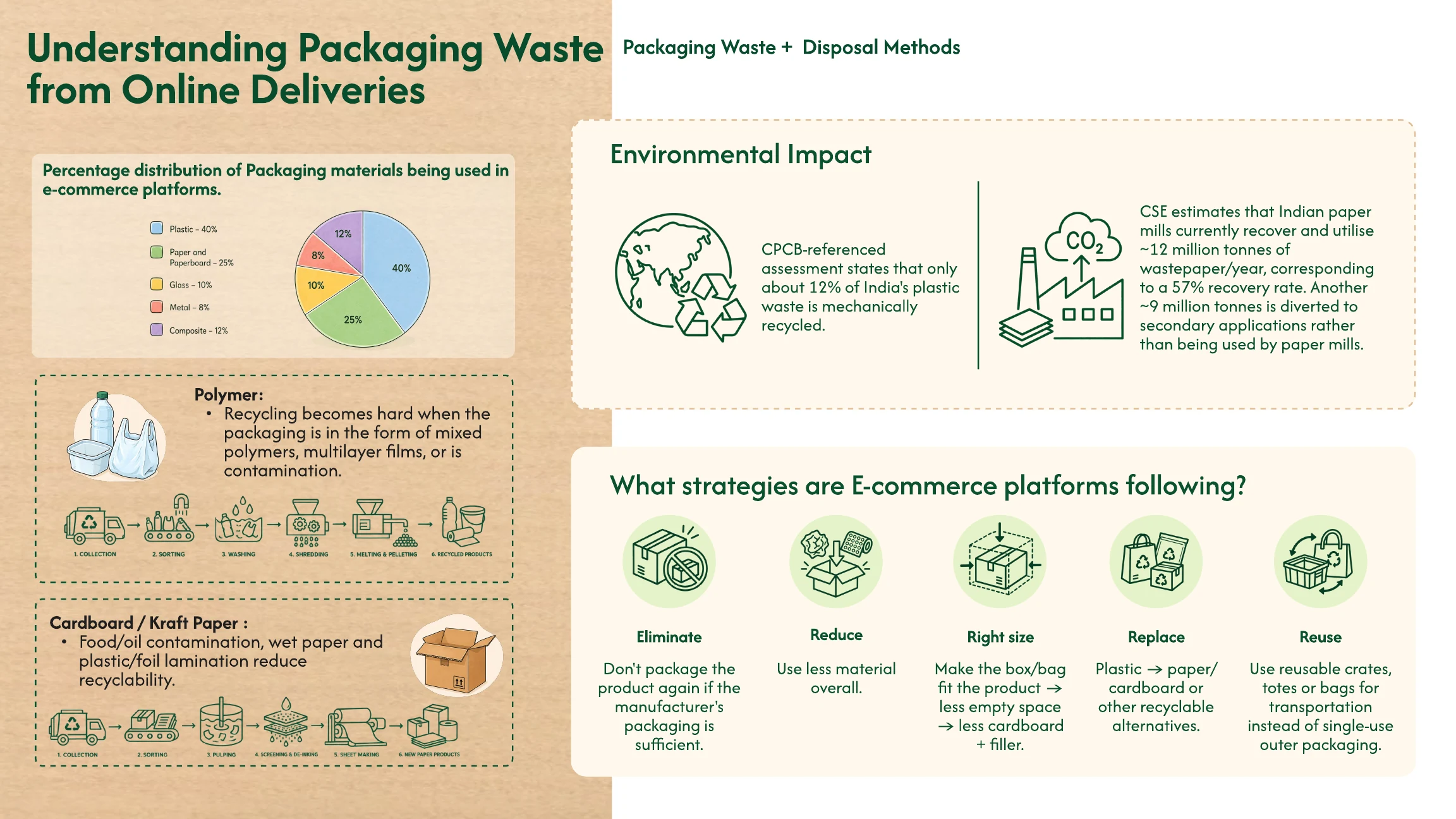
Understanding Packaging Waste Packaging Waste + Disposal Methods from Online Deliveries Percentage distribution of Packaging materials being used in e-commerce platforms. Environmental Impact CSE estimates that Indian paper mills currently recover and utilise ~12 million tonnes of wastepaper/year, corresponding to a 57% recovery rate. Another ~9 million tonnes is diverted to secondary applications rather than being used by paper mills. CPCB-referenced assessment states that only about 12% of India's plastic waste is mechanically recycled. Polymer: Recycling becomes hard when the packaging is in the form of mixed polymers, multilayer films, or is contamination. Cardboard / Kraft Paper : Food/oil contamination, wet paper and plastic/foil lamination reduce recyclability. What strategies are E-commerce platforms following? Eliminate Reduce Right size Replace Reuse Don't package the product again if the manufacturer's packaging is sufficient. Use less material Make the box/bag fit the product → Plastic → paper/ cardboard or other recyclable alternatives. Use reusable crates, overall. less empty space → less cardboard + filler. totes or bags for transportation instead of single-use outer packaging.
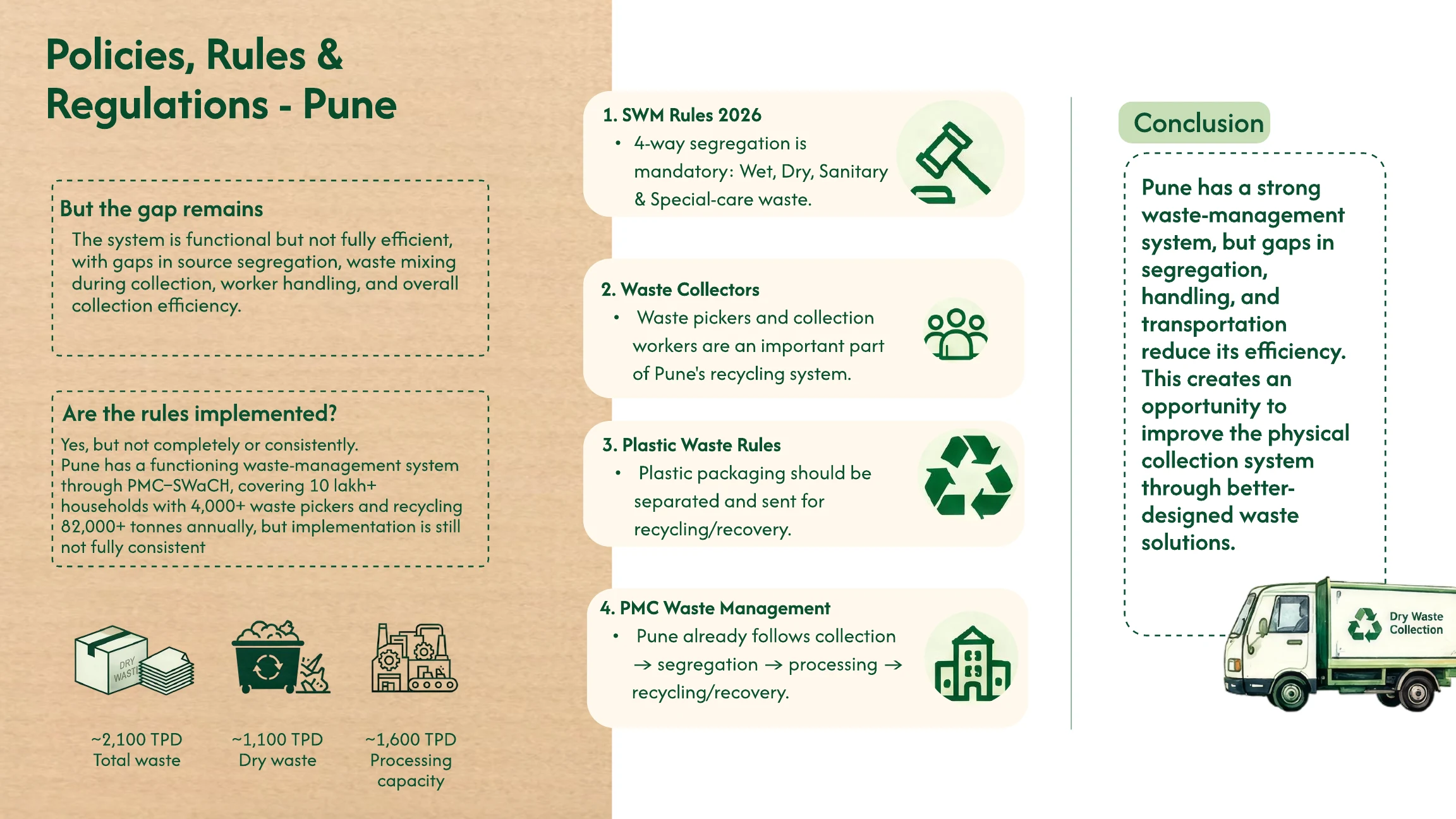
Policies, Rules & Regulations - Pune 1. SWM Rules 2026 Conclusion 4-way segregation is mandatory: Wet, Dry, Sanitary & Special-care waste. But the gap remains Pune has a strong waste-management The system is functional but not fully efficient, system, but gaps in with gaps in source segregation, waste mixing during collection, worker handling, and overall collection efficiency. segregation, 2. Waste Collectors Waste pickers and collection workers are an important part of Pune's recycling system. handling, and transportation reduce its efficiency. This creates an opportunity to Are the rules implemented? Yes, but not completely or consistently. 3. Plastic Waste Rules Pune has a functioning waste-management system improve the physical collection system Plastic packaging should be through PMC–SWaCH, covering 10 lakh+ through better- households with 4,000+ waste pickers and recycling 82,000+ tonnes annually, but implementation is still separated and sent for designed waste recycling/recovery. solutions. not fully consistent 4. PMC Waste Management Pune already follows collection → segregation → processing → recycling/recovery. ~2,100 TPD ~1,100 TPD ~1,600 TPD Total waste Dry waste Processing capacity
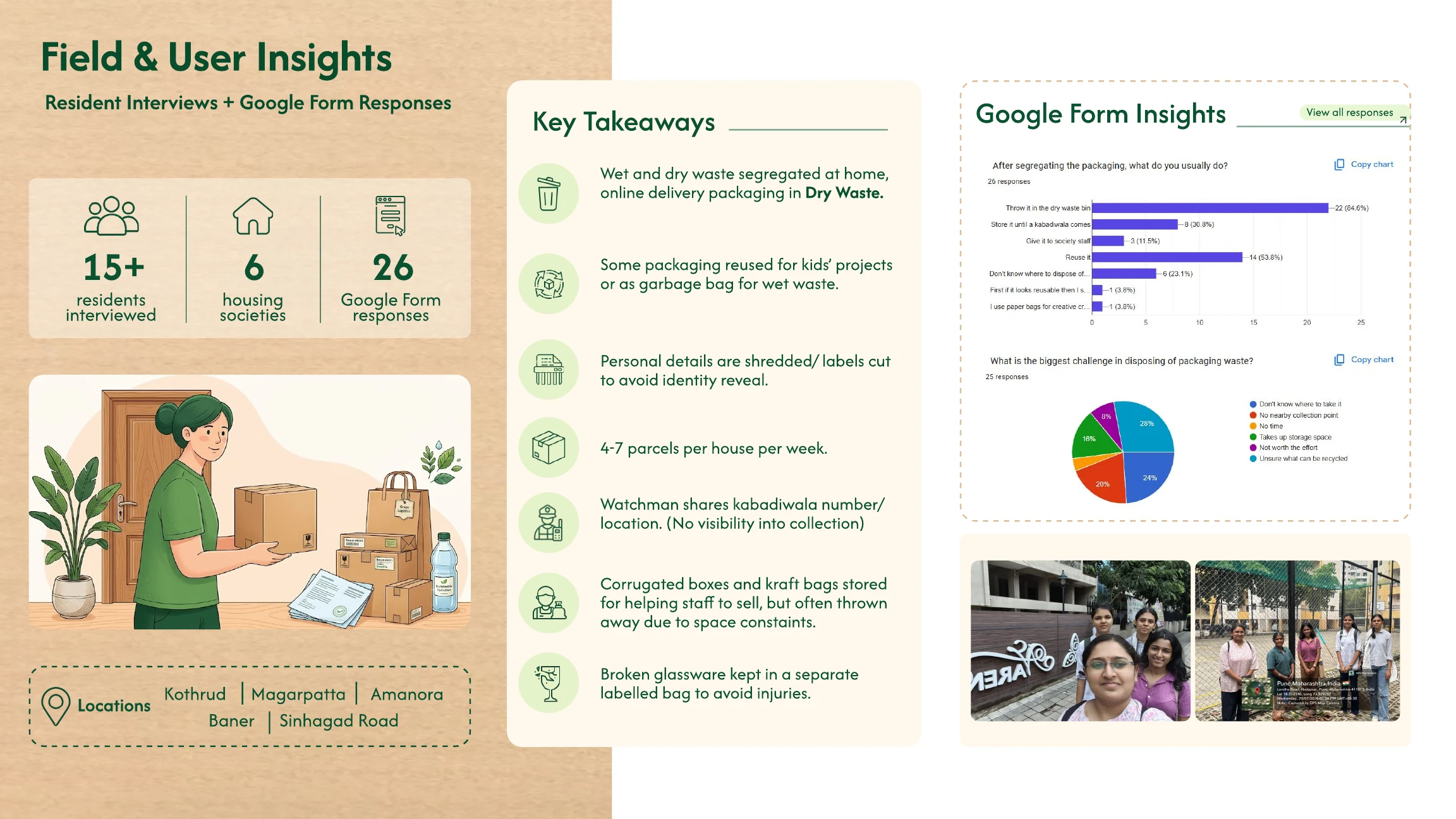
Field & User Insights Resident Interviews + Google Form Responses Key Takeaways Wet and dry waste segregated at home, online delivery packaging in Dry Waste. 15+ residents interviewed 6 housing societies 26 Google Form responses Some packaging reused for kids’ projects or as garbage bag for wet waste. Personal details are shredded/ labels cut to avoid identity reveal. 4-7 parcels per house per week. Watchman shares kabadiwala number/ location. (No visibility into collection) Corrugated boxes and kraft bags stored for helping staff to sell, but often thrown away due to space constaints. Kothrud Magarpatta Amanora Locations Baner Sinhagad Road Broken glassware kept in a separate labelled bag to avoid injuries. Google Form Insights View all responses
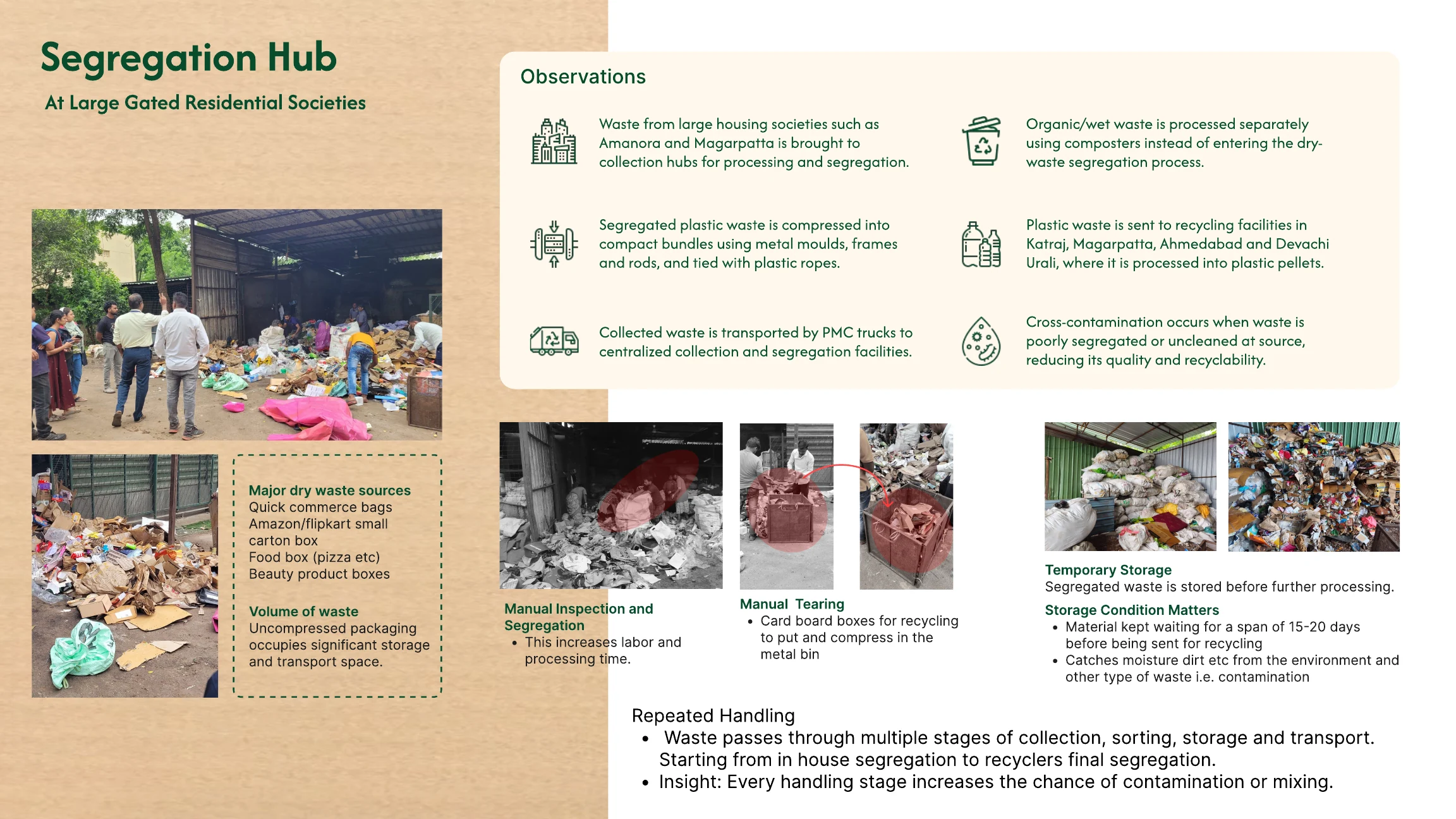
Segregation Hub Observations At Large Gated Residential Societies Waste from large housing societies such as Organic/wet waste is processed separately Amanora and Magarpatta is brought to using composters instead of entering the dry- collection hubs for processing and segregation. waste segregation process. Segregated plastic waste is compressed into Plastic waste is sent to recycling facilities in compact bundles using metal moulds, frames Katraj, Magarpatta, Ahmedabad and Devachi and rods, and tied with plastic ropes. Urali, where it is processed into plastic pellets. Collected waste is transported by PMC trucks to centralized collection and segregation facilities. Major dry waste sources Quick commerce bags Amazon/flipkart small carton box Food box (pizza etc) Beauty product boxes Volume of waste Uncompressed packaging occupies significant storage and transport space. Cross-contamination occurs when waste is poorly segregated or uncleaned at source, reducing its quality and recyclability. Temporary Storage Manual Inspection and Segregation This increases labor and processing time. Segregated waste is stored before further processing. Manual Tearing Card board boxes for recycling to put and compress in the metal bin Storage Condition Matters Material kept waiting for a span of 15-20 days before being sent for recycling Catches moisture dirt etc from the environment and other type of waste i.e. contamination epeated Handling Waste passes through multiple stages of collection, sorting, storage and transport. Starting from in house segregation to recyclers final segregation. Insight: Every handling stage increases the chance of contamination or mixing. R
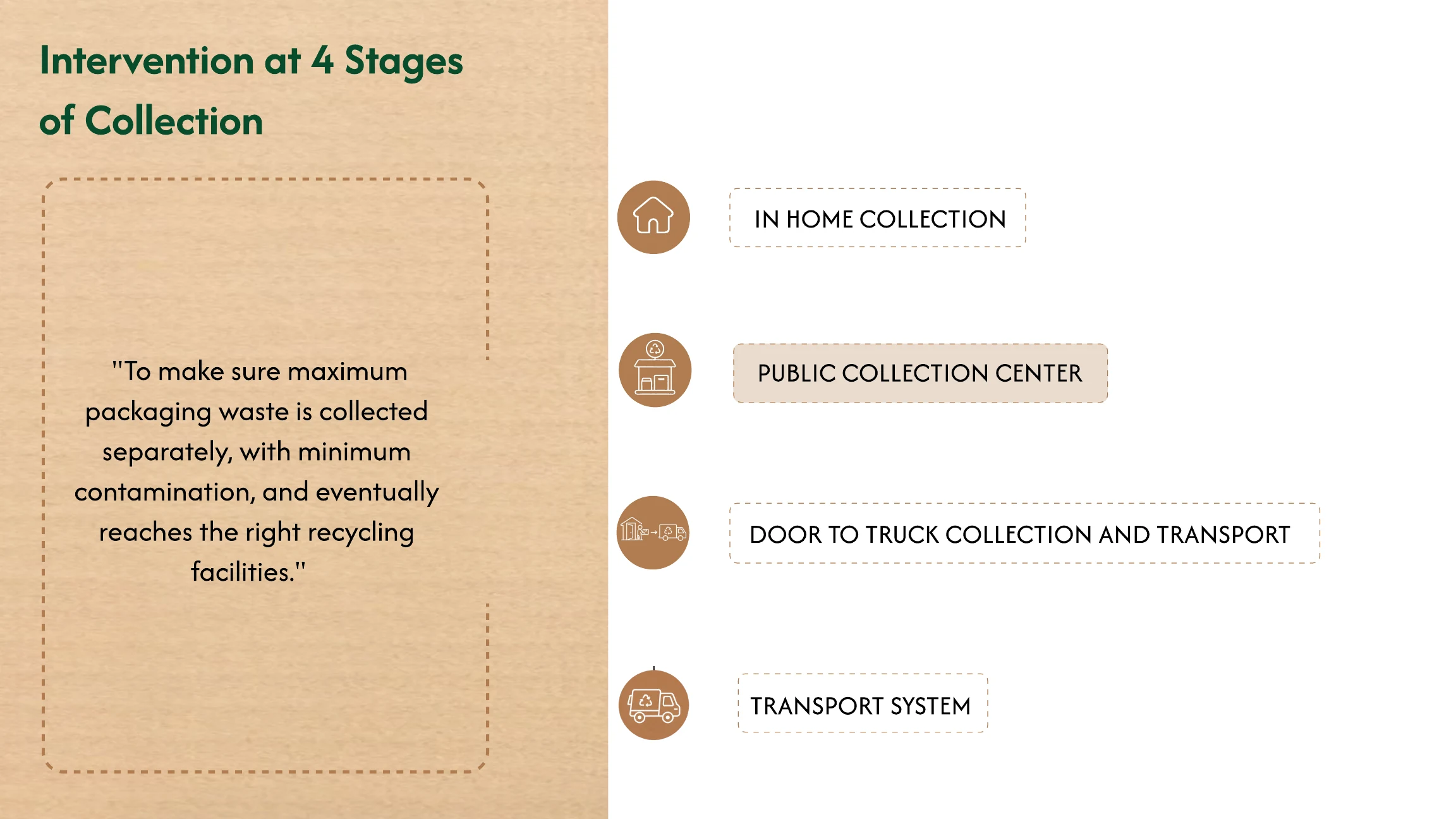
Intervention at 4 Stages of Collection IN HOME COLLECTION "To make sure maximum PUBLIC COLLECTION CENTER packaging waste is collected separately, with minimum contamination, and eventually reaches the right recycling Door to truck collection and transport facilities." TRANSPORT SYSTEM
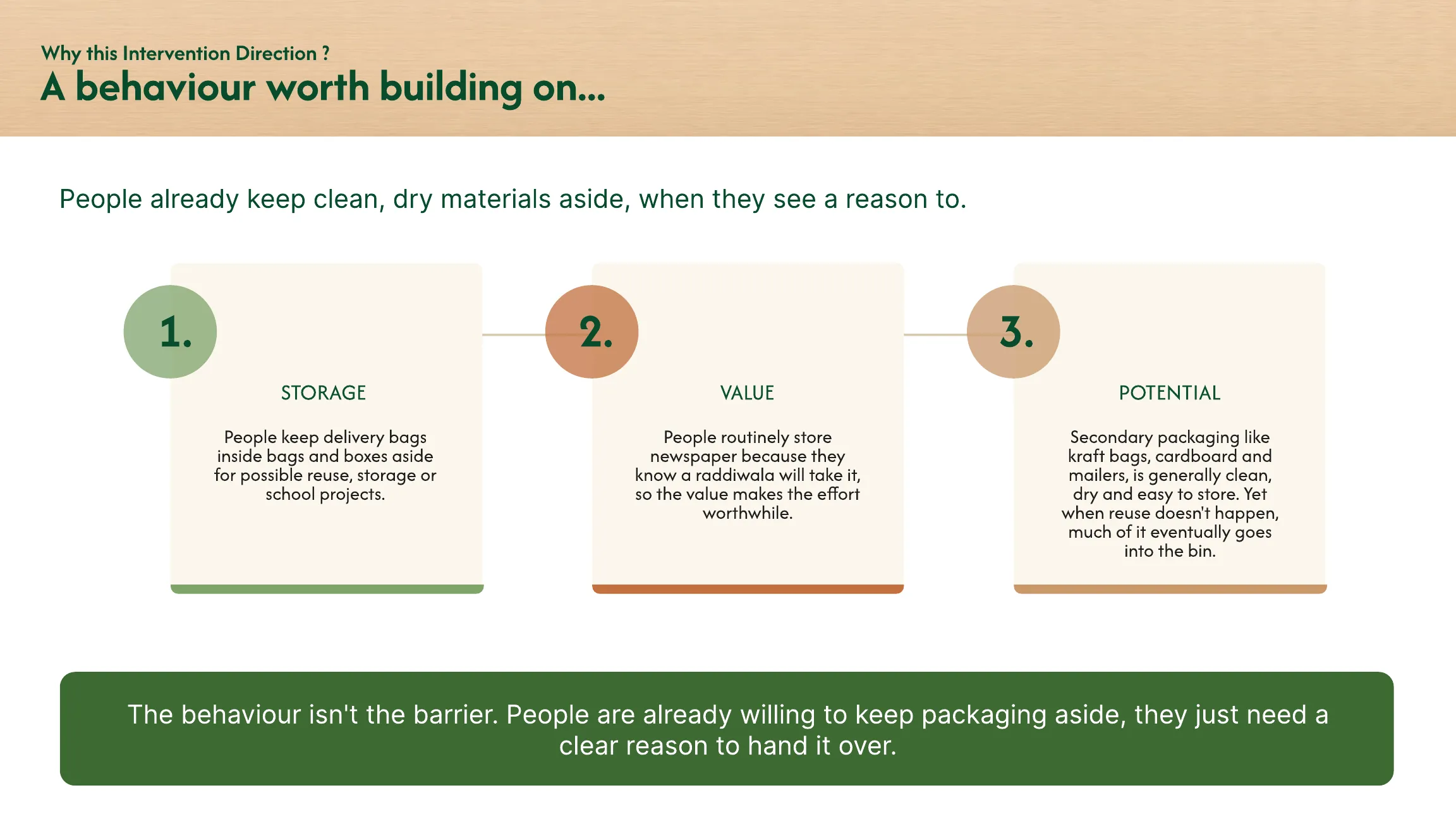
Why this Intervention Direction ? A behaviour worth building on... People already keep clean, dry materials aside, when they see a reason to. 1. 2. 3. STORAGE VALUE POTENTIAL People keep delivery bags People routinely store Secondary packaging like inside bags and boxes aside newspaper because they kraft bags, cardboard and for possible reuse, storage or know a raddiwala will take it, mailers, is generally clean, school projects. so the value makes the effort dry and easy to store. Yet worthwhile. when reuse doesn't happen, much of it eventually goes into the bin. The behaviour isn't the barrier. People are already willing to keep packaging aside, they just need a clear reason to hand it over.
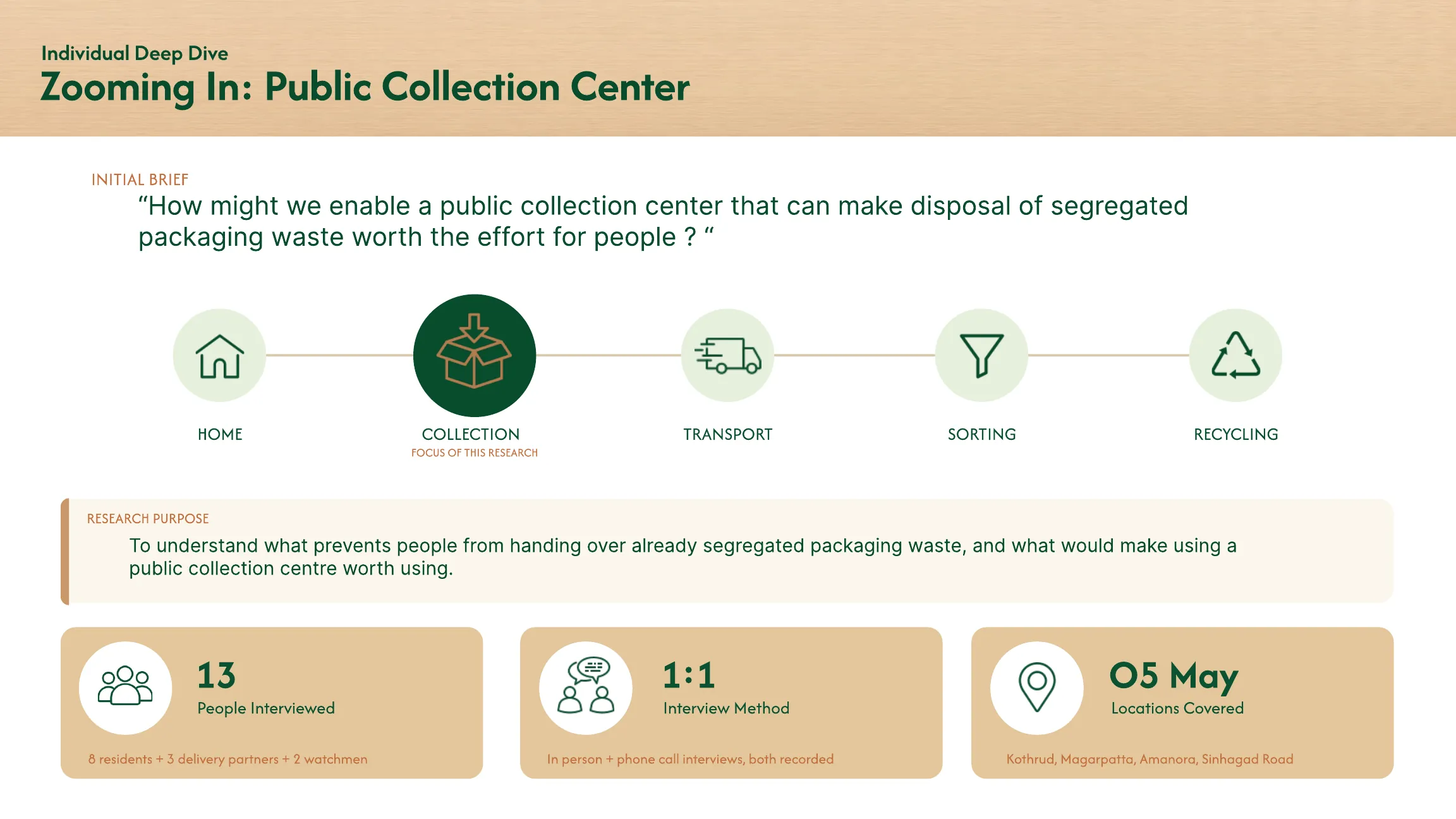
Individual Deep Dive Zooming In: Public Collection Center INITIAL BRIEF “How might we enable a public collection center that can make disposal of segregated packaging waste worth the effort for people ? “ HOME COLLECTION TRANSPORT SORTING RECYCLING FOCUS OF THIS RESEARCH RESEARCH PURPOSE To understand what prevents people from handing over already segregated packaging waste, and what would make using a public collection centre worth using. 13 1:1 O5 May People Interviewed FOCUS OF THIS RESEARCH Interview Method Locations Covered 8 residents + 3 delivery partners + 2 watchmen In person + phone call interviews, both recorded Kothrud, Magarpatta, Amanora, Sinhagad Road
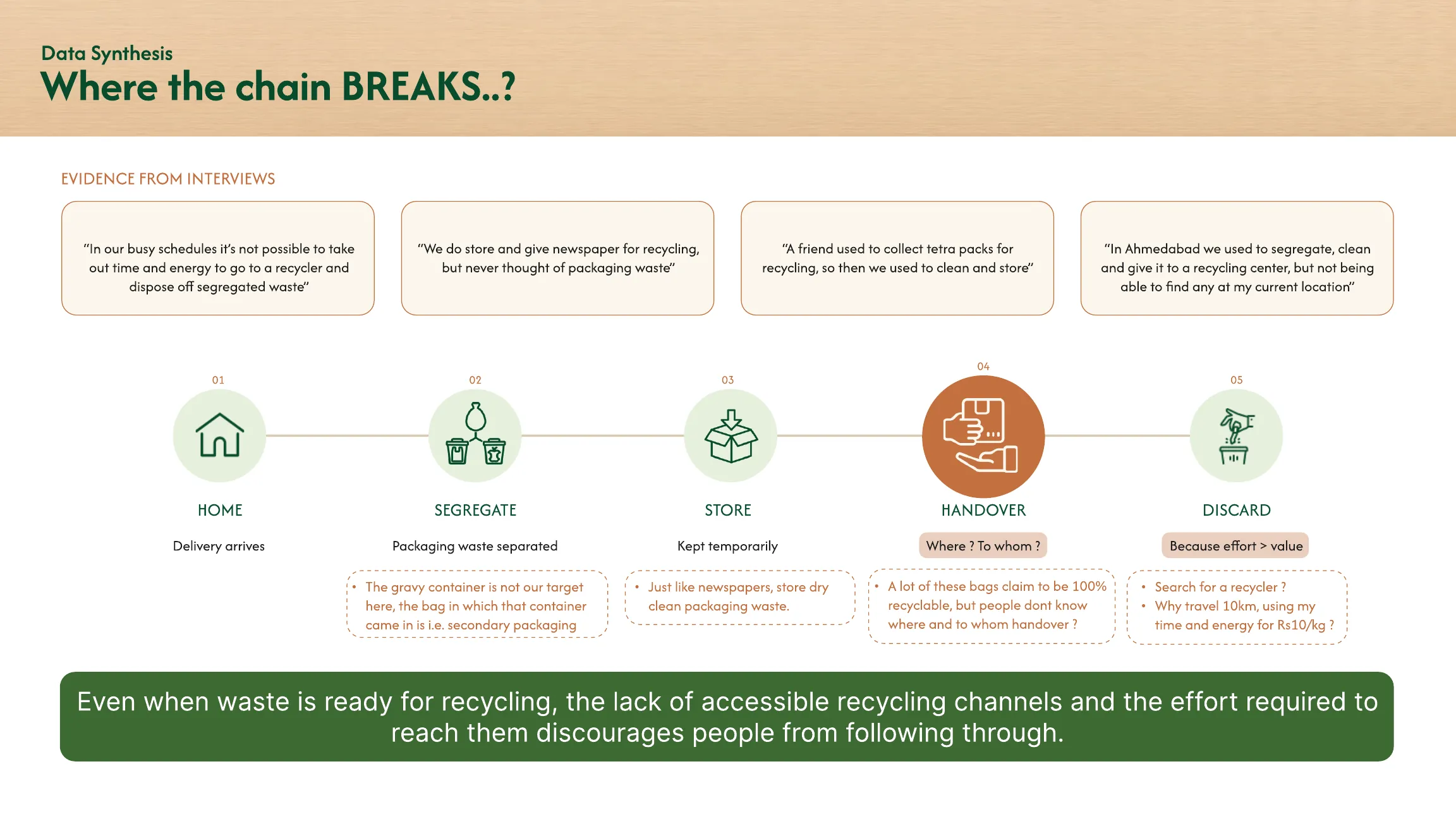
Data Synthesis Where the chain BREAKS..? EVIDENCE FROM INTERVIEWS “In our busy schedules it’s not possible to take out time and energy to go to a recycler and dispose off segregated waste” “We do store and give newspaper for recycling, but never thought of packaging waste” “A friend used to collect tetra packs for recycling, so then we used to clean and store” “In Ahmedabad we used to segregate, clean and give it to a recycling center, but not being able to find any at my current location” 04 01 02 03 HOME SEGREGATE STORE HANDOVER DISCARD Delivery arrives Packaging waste separated Kept temporarily Where ? To whom ? Because effort > value The gravy container is not our target here, the bag in which that container came in is i.e. secondary packaging J ust like newspapers, store dry clean packaging waste. A lot of these bags claim to be 100 % recyclable, but people dont know where and to whom handover ? 05 Search for a recycler ? Why travel 10km, using my time and energy for Rs10/kg ? Even when waste is ready for recycling, the lack of accessible recycling channels and the effort required to reach them discourages people from following through.
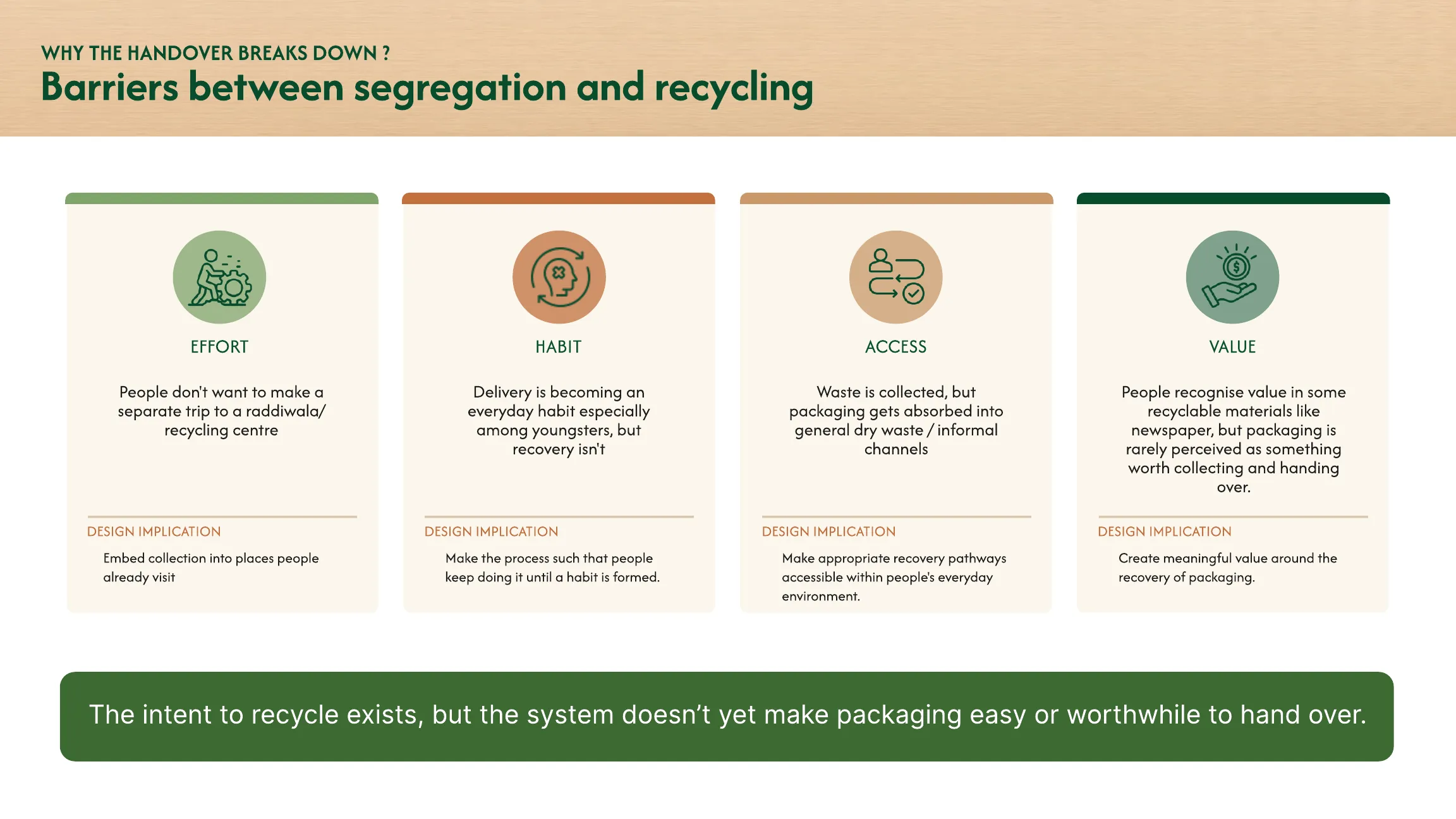
WHY THE HANDOVER BREAKS DOWN ? Barriers between segregation and recycling EFFORT HABIT ACCESS VALUE People don't want to make a Delivery is becoming an Waste is collected, but People recognise value in some separate trip to a raddiwala/ everyday habit especially packaging gets absorbed into recyclable materials like recycling centre among youngsters, but general dry waste / informal newspaper, but packaging is recovery isn't channels rarely perceived as something worth collecting and handing over. DESIGN IMPLICATION DESIGN IMPLICATION DESIGN IMPLICATION DESIGN IMPLICATION Embed collection into places people Make the process such that people Make appropriate recovery pathways Create meaningful value around the already visit keep doing it until a habit is formed. accessible within people's everyday recovery of packaging. environment. The intent to recycle exists, but the system doesn’t yet make packaging easy or worthwhile to hand over.
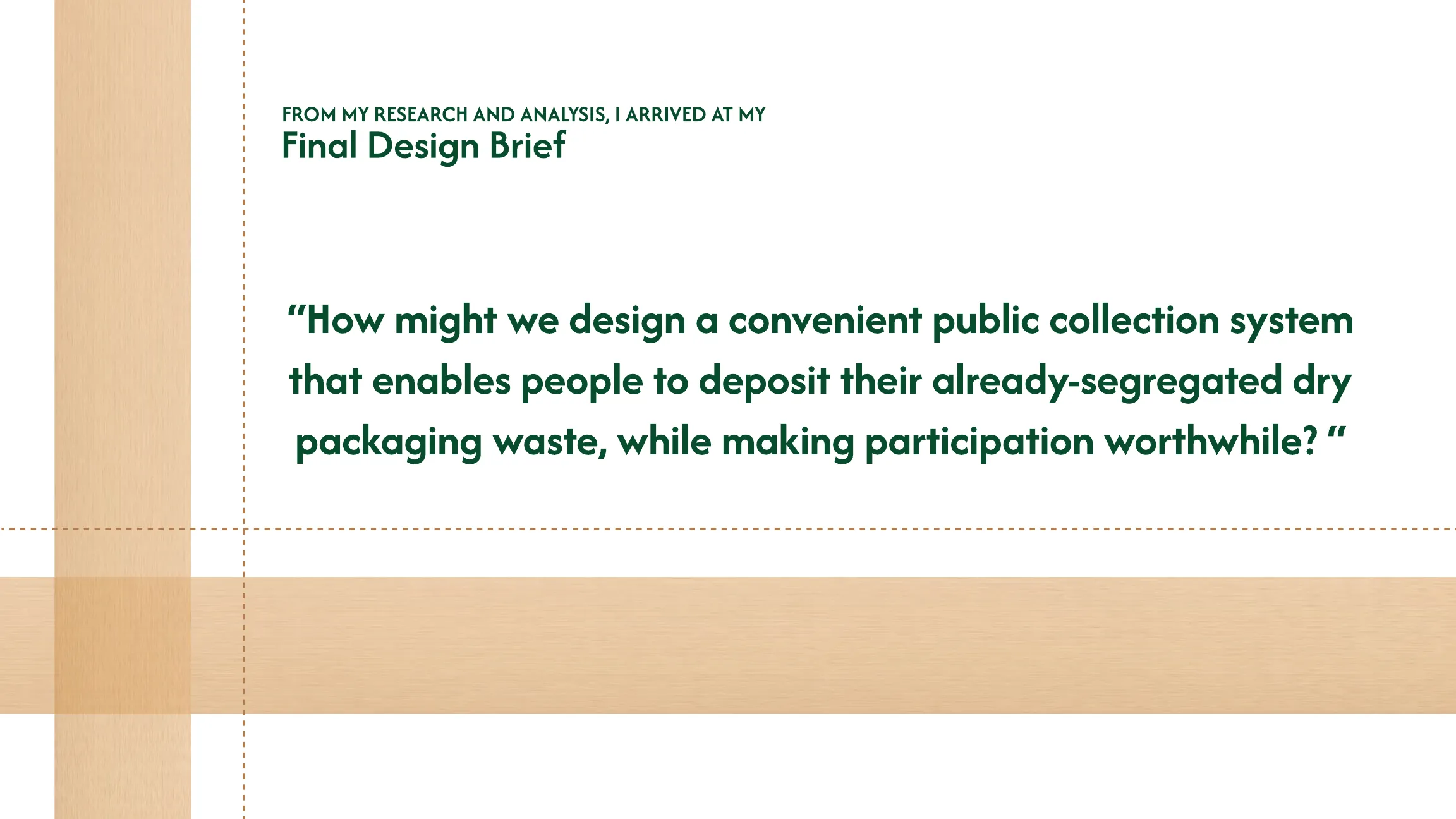
FROM MY RESEARCH AND ANALYSIS, I ARRIVED AT MY Final Design Brief “How might we design a convenient public collection system that enables people to deposit their already-segregated dry packaging waste, while making participation worthwhile? “
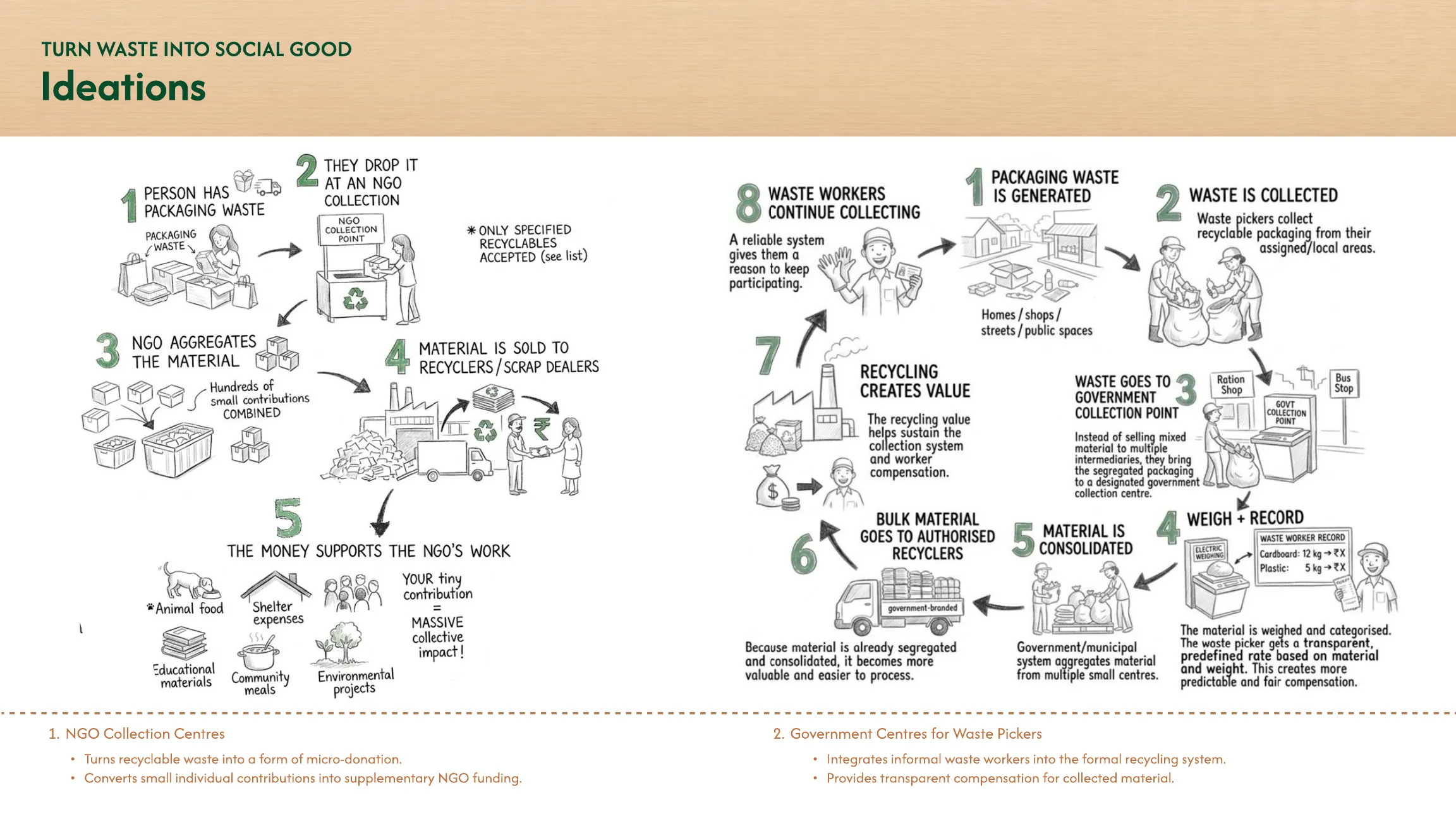
TURN WASTE INTO SOCIAL GOOD Ideations NGO Collection Centres Turns recyclable waste into a form of micro-donation. Converts small individual contributions into supplementary NGO funding. Government Centres for Waste Pickers Integrates informal waste workers into the formal recycling system. Provides transparent compensation for collected material.
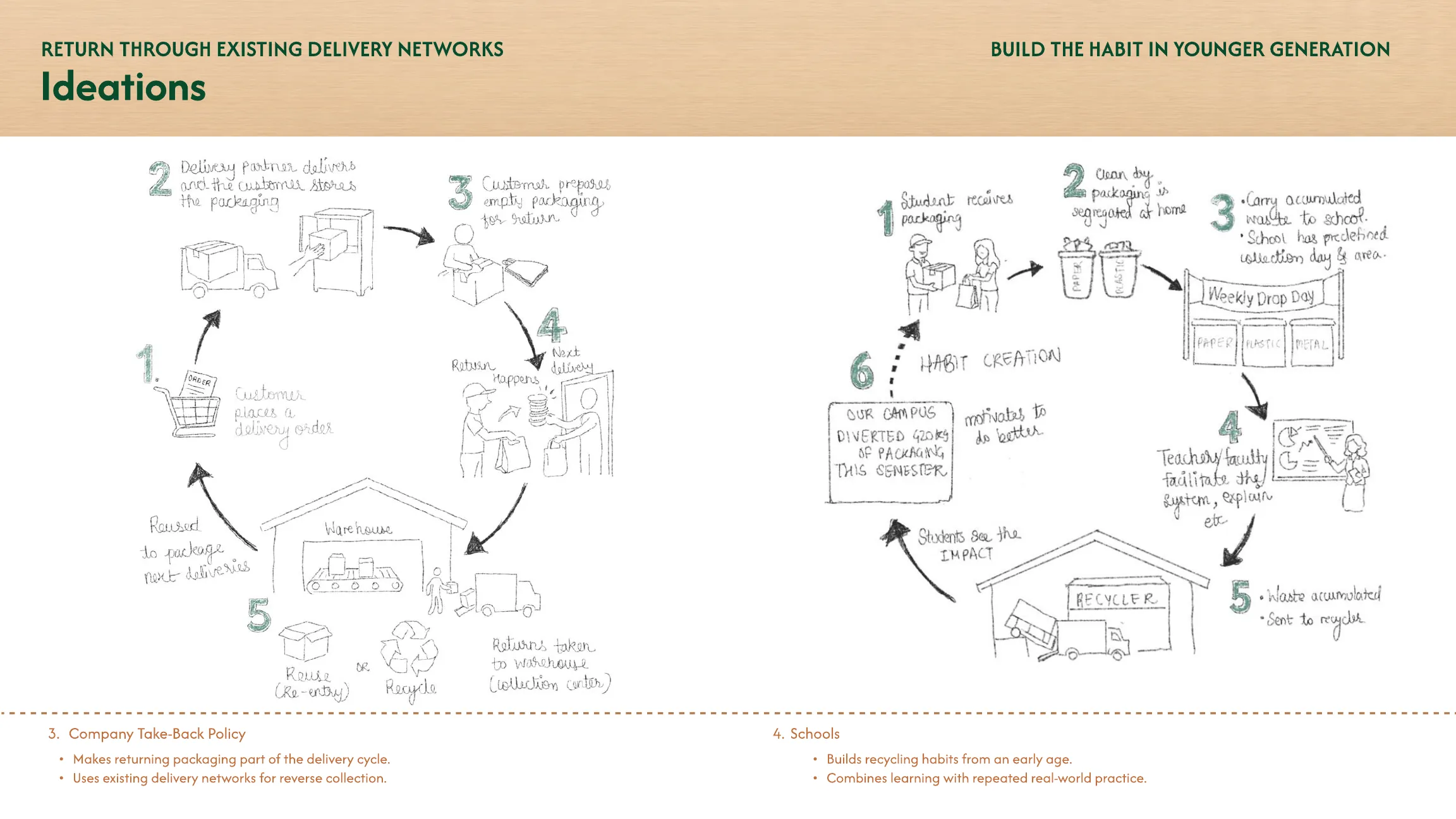
RETURN THROUGH EXISTING DELIVERY NETWORKS BUILD THE HABIT IN YOUNGER GENERATION Ideations Company Take-Back Policy Makes returning packaging part of the delivery cycle. Uses existing delivery networks for reverse collection. Schools Builds recycling habits from an early age. Combines learning with repeated real-world practice.
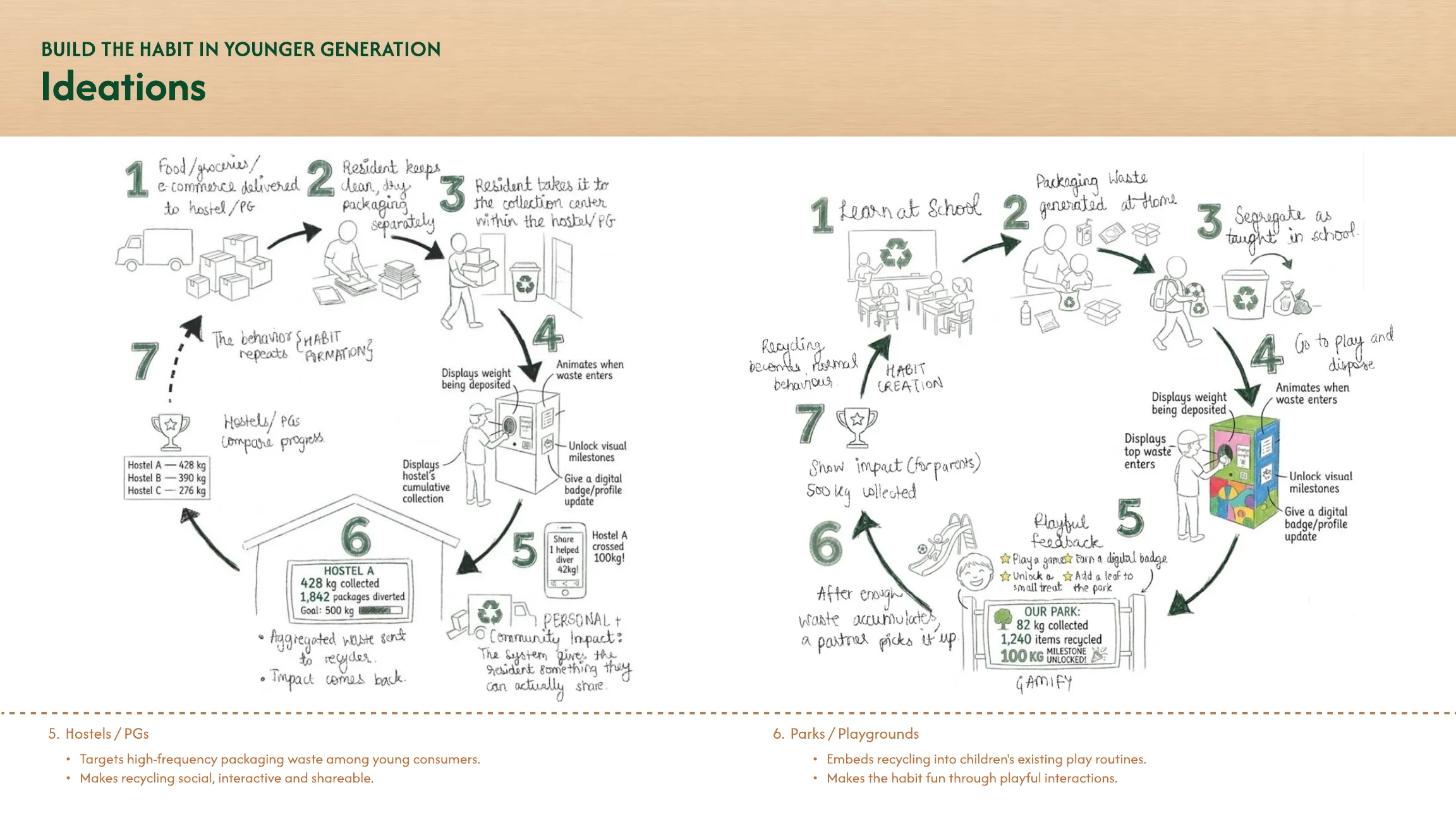
BUILD THE HABIT IN YOUNGER GENERATION Ideations Hostels / PGs Targets high-frequency packaging waste among young consumers. Makes recycling social, interactive and shareable. Parks / Playgrounds Embeds recycling into children's existing play routines. Makes the habit fun through playful interactions.
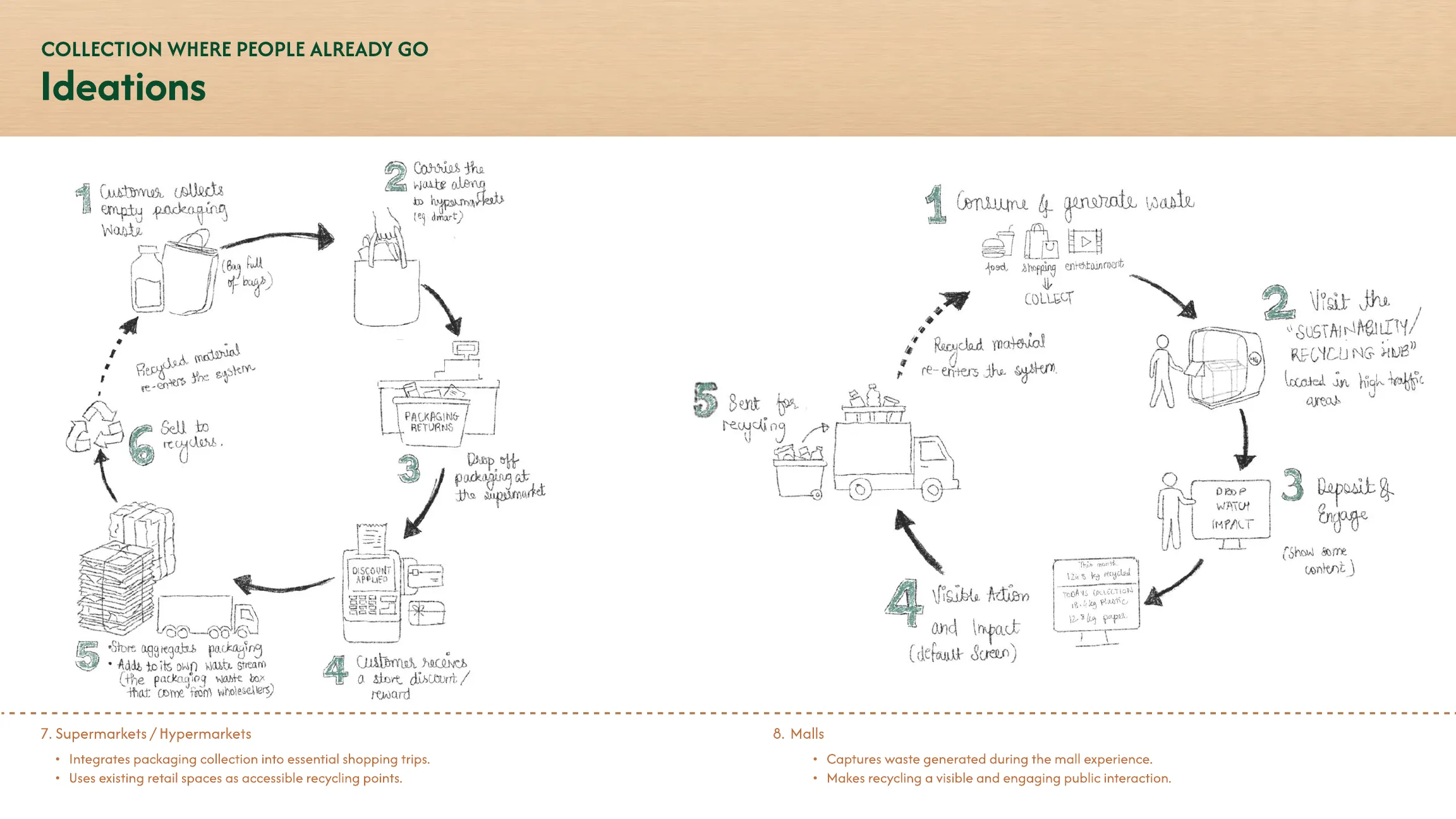
COLLECTION WHERE PEOPLE ALREADY GO Ideations 7. Supermarkets / Hypermarkets Integrates packaging collection into essential shopping trips. Uses existing retail spaces as accessible recycling points. Malls Captures waste generated during the mall experience. Makes recycling a visible and engaging public interaction.
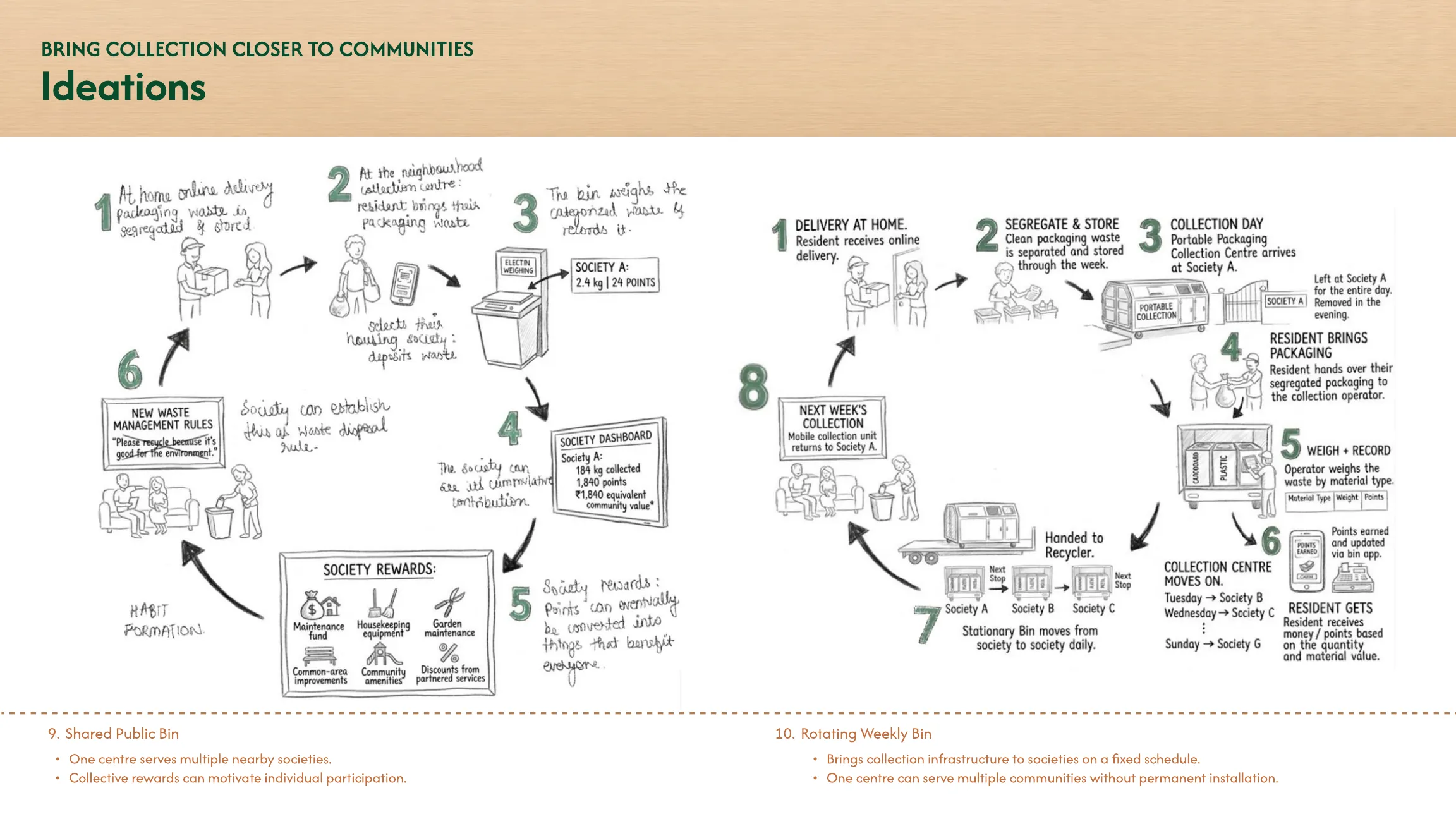
BRING COLLECTION CLOSER TO COMMUNITIES Ideations Shared Public Bin One centre serves multiple nearby societies. Collective rewards can motivate individual participation. Rotating Weekly Bin Brings collection infrastructure to societies on a fixed schedule. One centre can serve multiple communities without permanent installation.
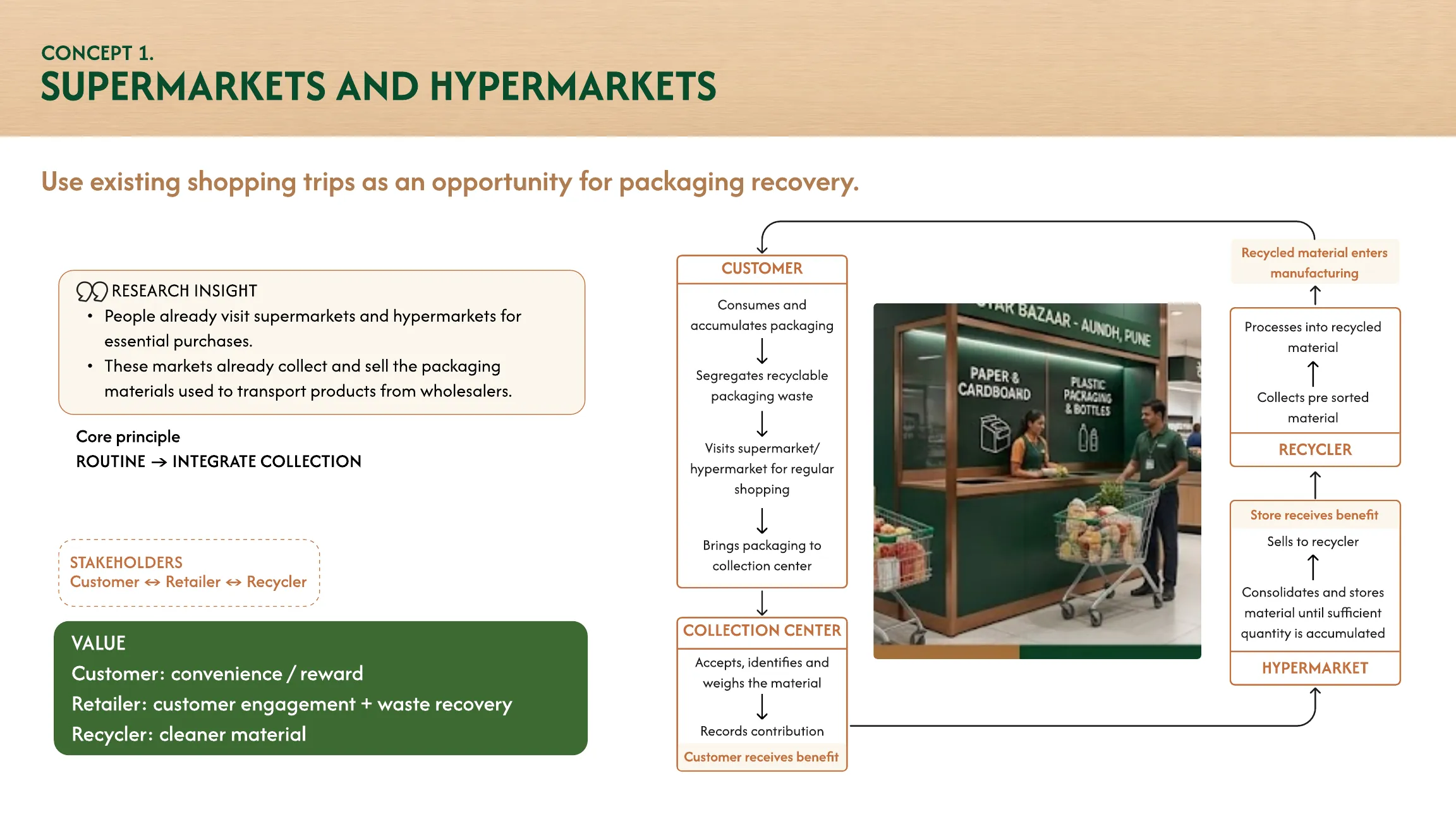
CONCEPT 1. SUPERMARKETS AND HYPERMARKETS Use existing shopping trips as an opportunity for packaging recovery. RESEARCH INSIGHT People already visit supermarkets and hypermarkets for essential purchases. These markets already collect and sell the packaging materials used to transport products from wholesalers. Core principle ROUTINE → INTEGRATE COLLECTION Recyc e ateria enters anufacturing l CUSTOMER l m Consumes and accumulates packaging Segregates recyclable packaging waste isits supermarket hypermarket for regular shopping V d m / Processes into recycled material Collects pre sorted material REC CLER Y Store receives ene t b STAKEHOLDERS Customer ↔ Retailer ↔ Recycler VALUE Customer: convenience / reward Retailer: customer engagement + waste recovery Recycler: cleaner material Sells to recycler Brings packaging to collection center COLLECTION CENTER Accepts, identifies and weighs the material Records contribution Custo er receives ene t m b fi fi Consolidates and stores material until sufficient quantity is accumulated PERM R ET HY A K
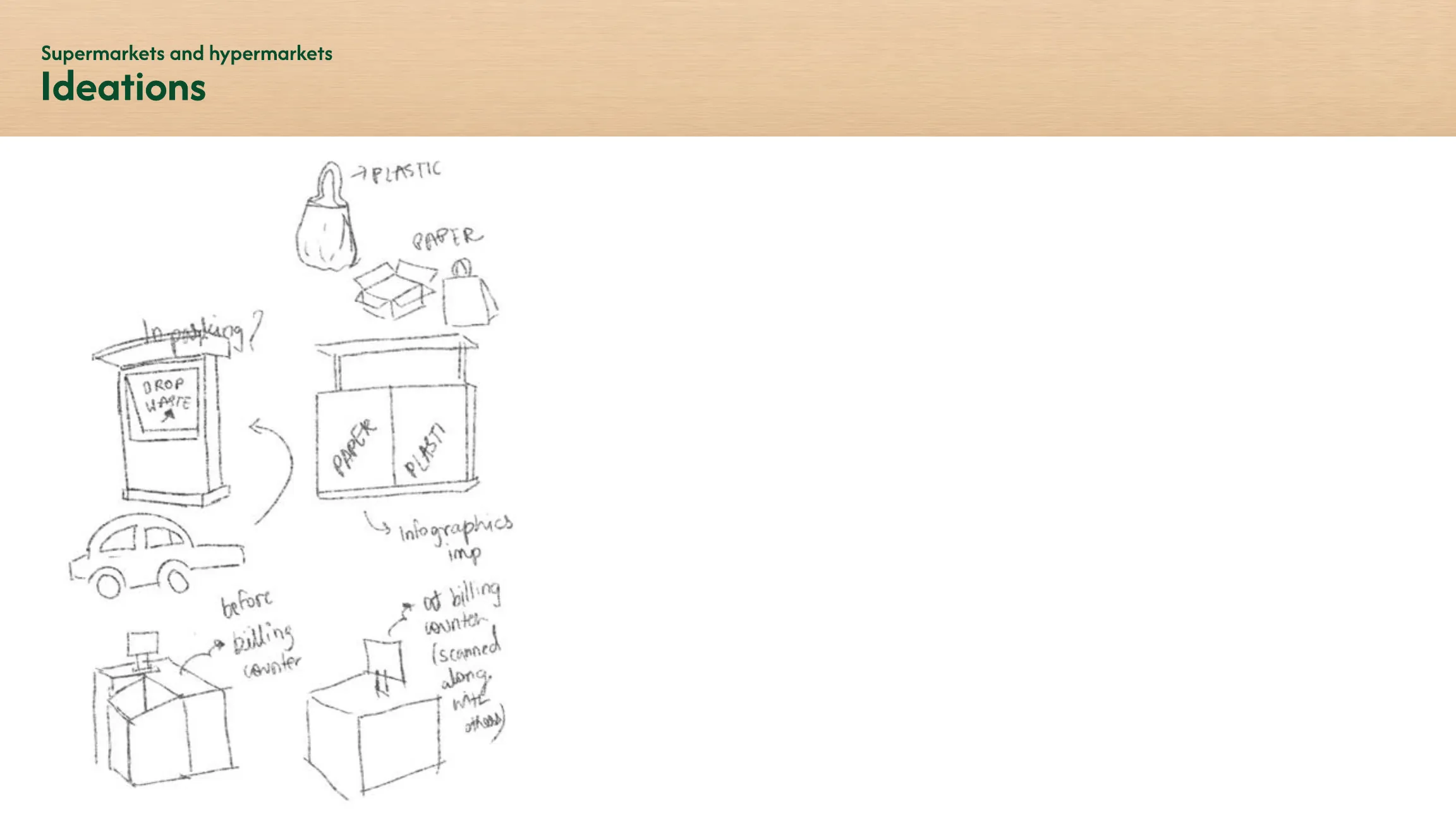
Supermarkets and hypermarkets Ideations
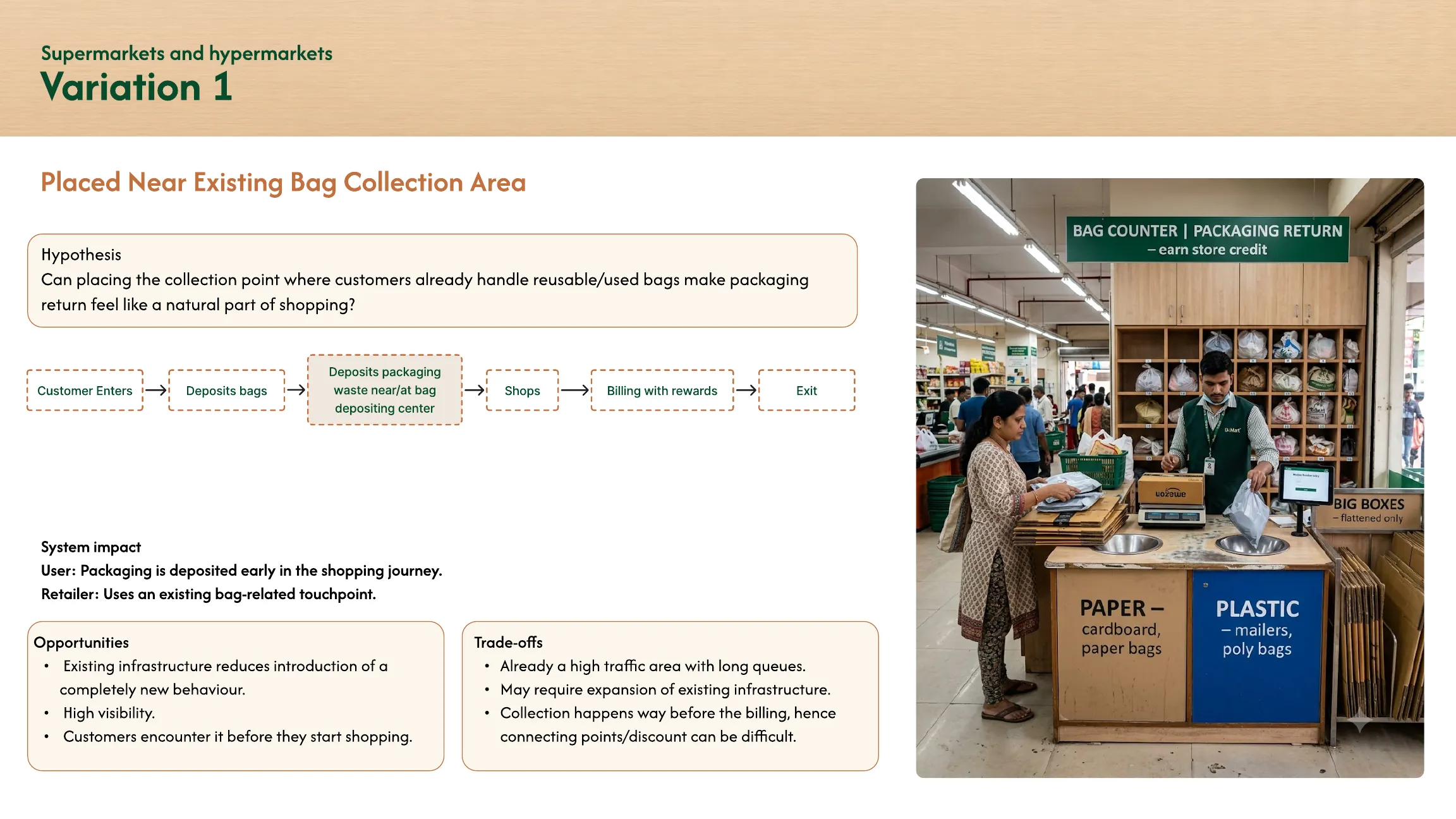
Supermarkets and hypermarkets Variation 1 Placed Near Existing Bag Collection Area Hypothesis Can placing the collection point where customers already handle reusable/used bags make packaging return feel like a natural part of shopping? Deposits packaging Customer Enters Deposits bags waste near/at bag Shops Billing with rewards Exit depositing center System impact User: Packaging is deposited early in the shopping journey. Retailer: Uses an existing bag-related touchpoint. Opportunities Existing infrastructure reduces introduction of a completely new behaviour. High visibility. Customers encounter it before they start shopping. Trade-offs Already a high traffic area with long queues. May require expansion of existing infrastructure. Collection happens way before the billing, hence connecting points/discount can be difficult.
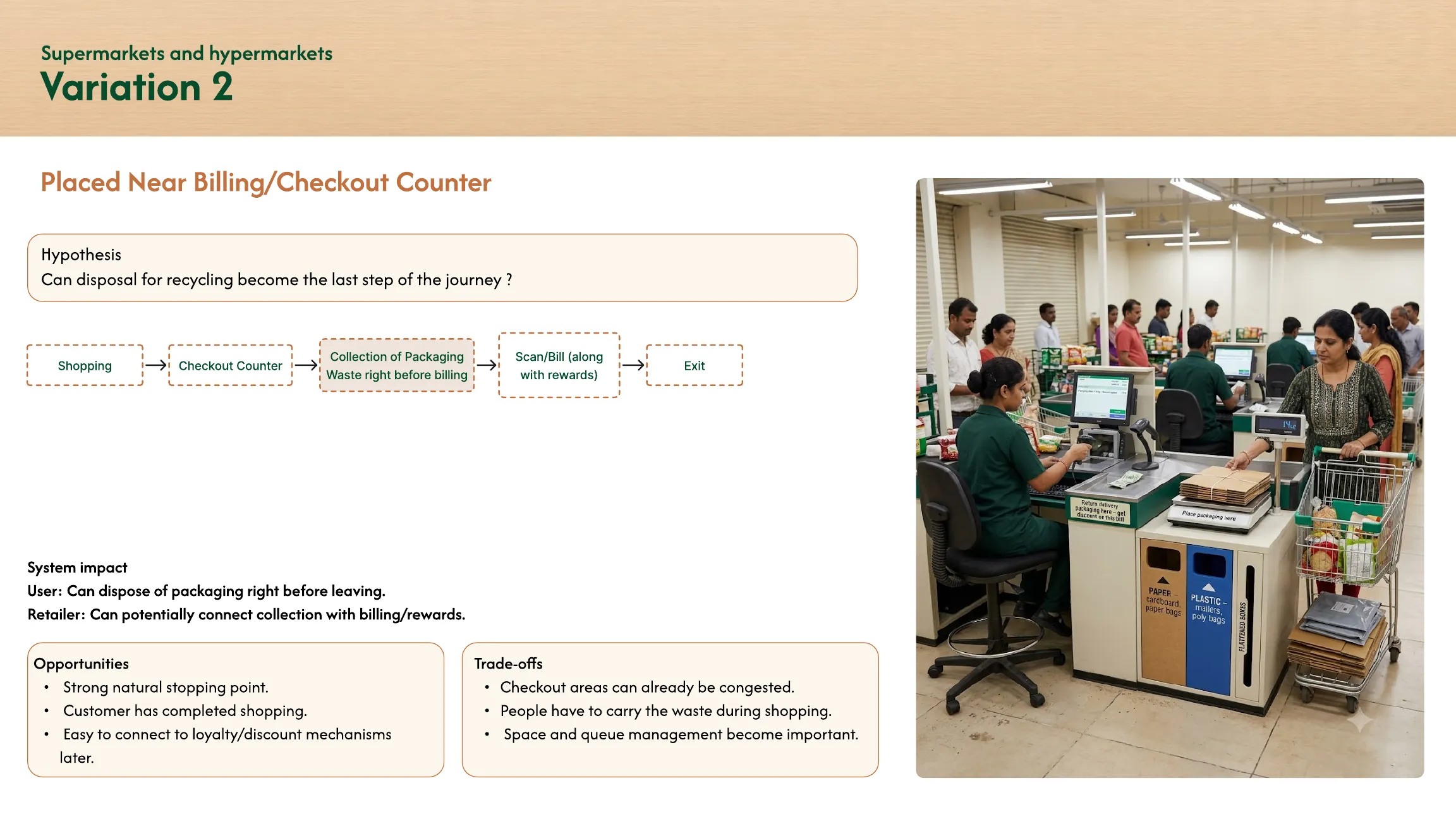
Supermarkets and hypermarkets Variation 2 Placed Near Billing/Checkout Counter Hypothesis Can disposal for recycling become the last step of the journey ? Shopping Checkout Counter Collection of Packaging Scan/Bill (along Waste right before billing with rewards) Exit System impact User: Can dispose of packaging right before leaving. Retailer: Can potentially connect collection with billing/rewards. Opportunities Strong natural stopping point. Customer has completed shopping. Easy to connect to loyalty/discount mechanisms later. Trade-offs Checkout areas can already be congested. People have to carry the waste during shopping. Space and queue management become important.
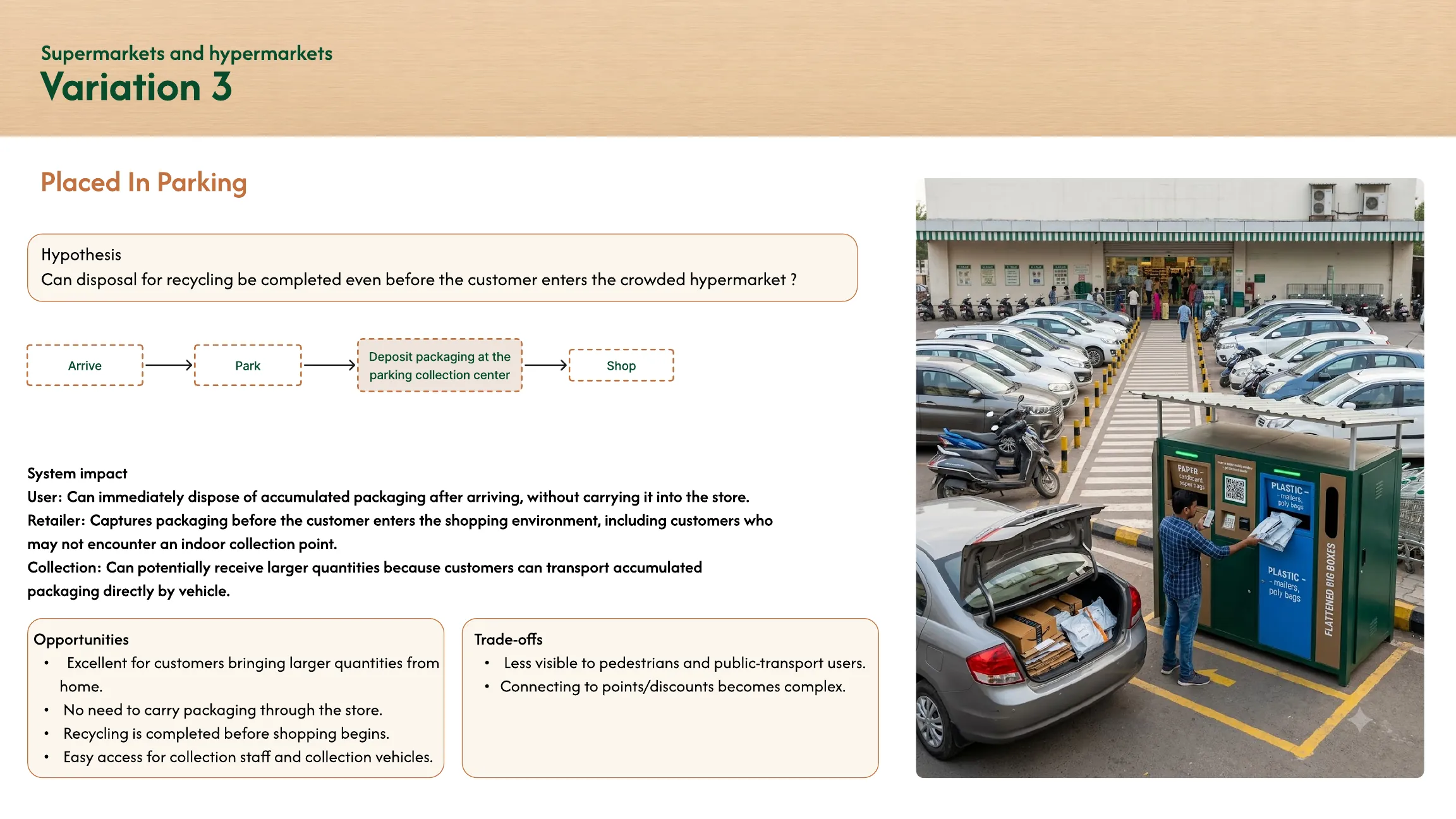
Supermarkets and hypermarkets Variation 3 Placed In Parking Hypothesis Can disposal for recycling be completed even before the customer enters the crowded hypermarket ? Arrive Park Deposit packaging at the parking collection center Shop System impact User: Can immediately dispose of accumulated packaging after arriving, without carrying it into the store. Retailer: Captures packaging before the customer enters the shopping environment, including customers who may not encounter an indoor collection point. Collection: Can potentially receive larger quantities because customers can transport accumulated packaging directly by vehicle. Opportunities Excellent for customers bringing larger quantities from home. No need to carry packaging through the store. Recycling is completed before shopping begins. Easy access for collection staff and collection vehicles. Trade-offs Less visible to pedestrians and public-transport users. Connecting to points/discounts becomes complex.
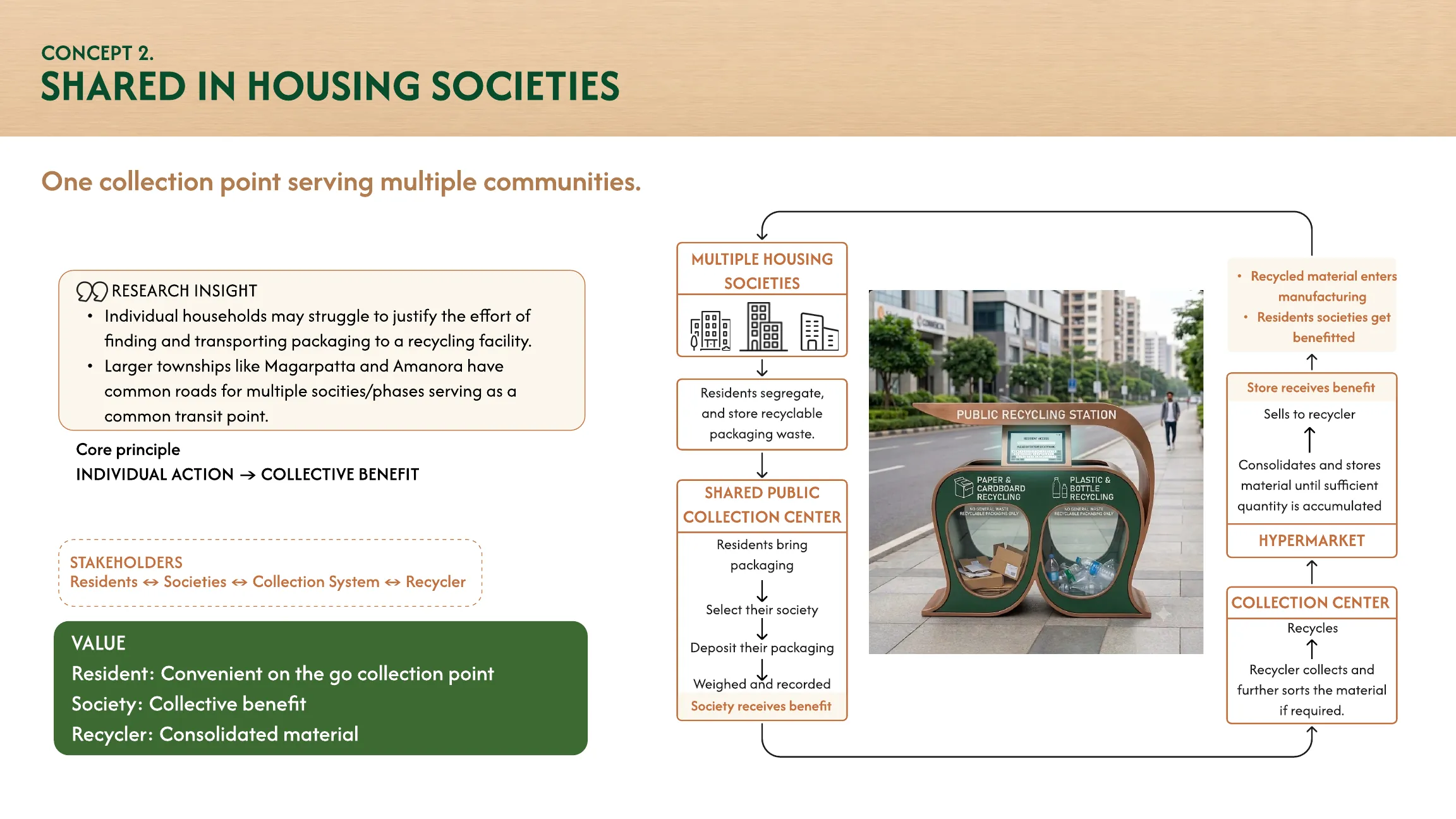
CONCEPT 2. SHARED IN HOUSING SOCIETIES One collection point serving multiple communities. RESEARCH INSIGHT Individual households may struggle to justify the effort of finding and transporting packaging to a recycling facility. Larger townships like Magarpatta and Amanora have common roads for multiple socities/phases serving as a common transit point. Core principle INDIVIDUAL ACTION → COLLECTIVE BENEFIT STAKEHOLDERS Residents ↔ Societies ↔ Collection System ↔ Recycler MULTIPLE HOUSING SOCIETIES Residents segregate, and store recyclable packaging waste. SHARED PUBLIC COLLECTION CENTER Residents bring packaging Select their society VALUE Resident: Convenient on the go collection point Society: Collective benefit Recycler: Consolidated material Deposit their packaging Weighed and recorded Society receives benefit Rec ycled material enters manufacturing Residents societies get benefitted Store receives benefit Sells to recycler Consolidates and stores material until sufficient quantity is accumulated HYPERMARKET COLLECTION CENTER Recycles Recycler collects and further sorts the material if required.
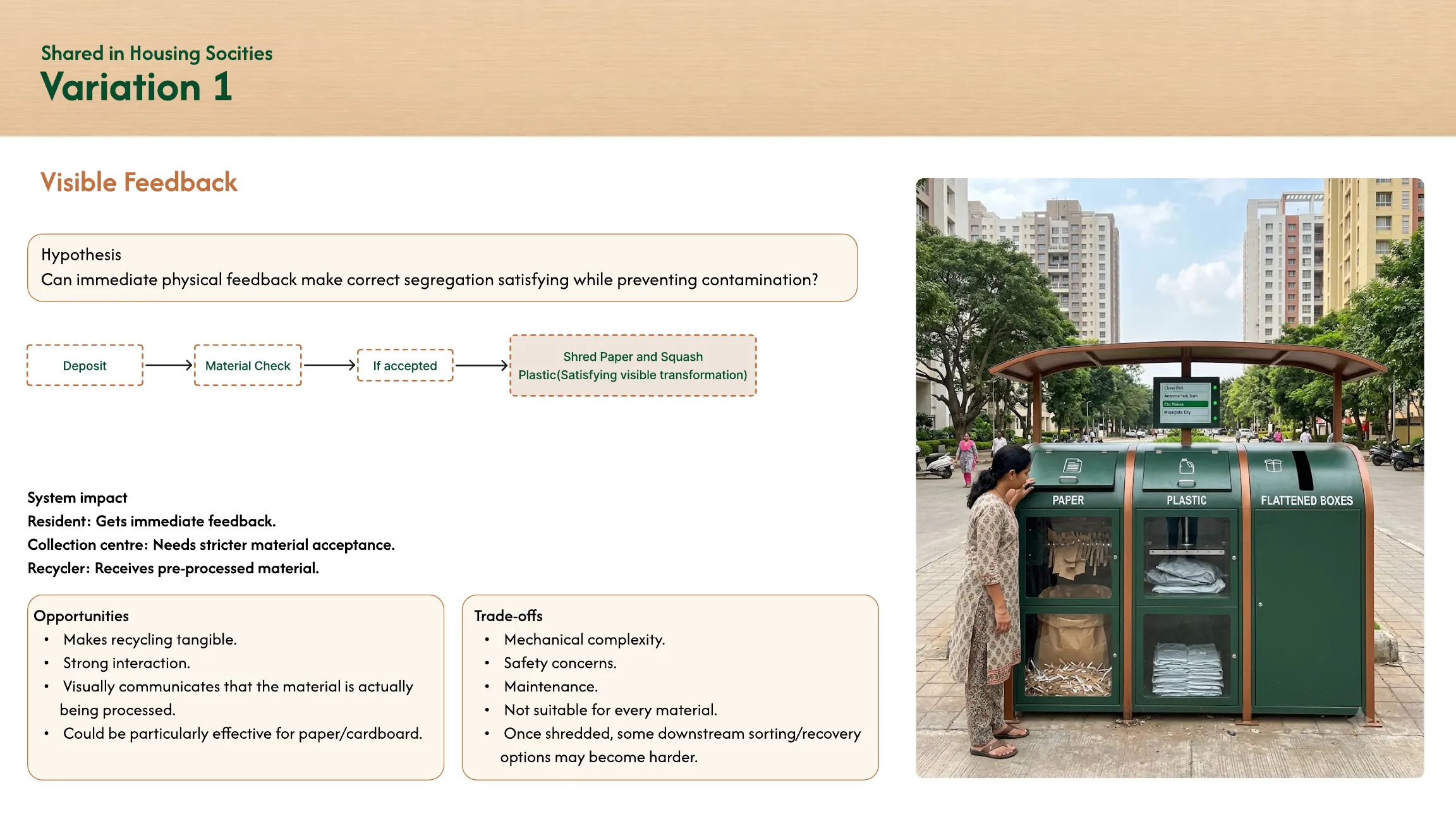
Shared in Housing Socities Variation 1 Visible Feedback Hypothesis Can immediate physical feedback make correct segregation satisfying while preventing contamination? Deposit Material Check If accepted Shred Paper and Squash Plastic(Satisfying visible transformation) System impact Resident: Gets immediate feedback. Collection centre: Needs stricter material acceptance. Recycler: Receives pre-processed material. Opportunities Makes recycling tangible. Strong interaction. Visually communicates that the material is actually being processed. Could be particularly effective for paper/cardboard. Trade-offs Mechanical complexity. Safety concerns. Maintenance. Not suitable for every material. Once shredded, some downstream sorting/recovery options may become harder.
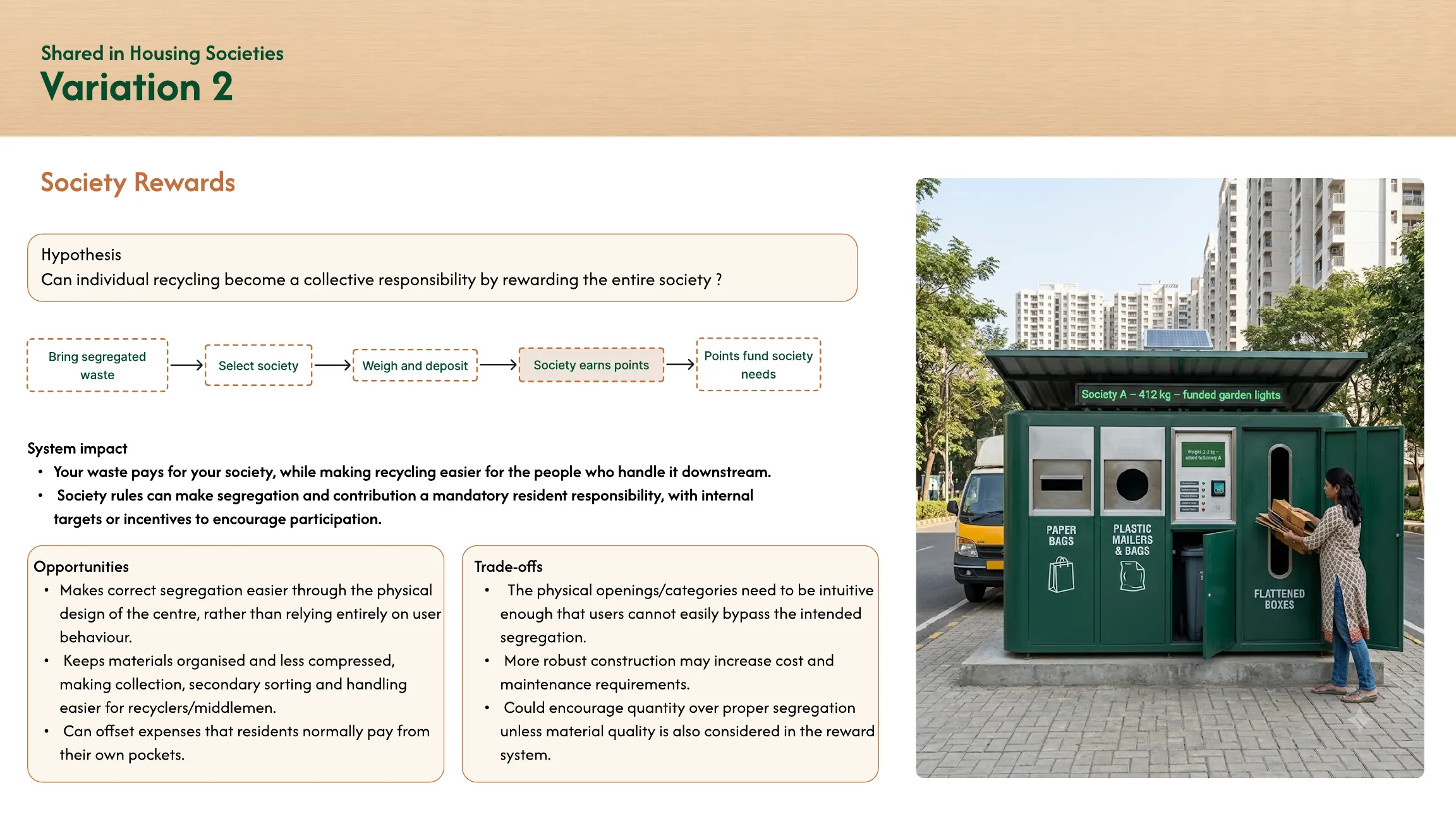
Shared in Housing Societies Variation 2 Society Rewards Hypothesis Can individual recycling become a collective responsibility by rewarding the entire society ? Bring segregated waste Select society Weigh and deposit Society earns points Points fund society needs System impact Your waste pays for your society, while making recycling easier for the people who handle it downstream. Society rules can make segregation and contribution a mandatory resident responsibility, with internal targets or incentives to encourage participation. Opportunities Makes correct segregation easier through the physical design of the centre, rather than relying entirely on user behaviour. Keeps materials organised and less compressed, making collection, secondary sorting and handling easier for recyclers/middlemen. Can offset expenses that residents normally pay from their own pockets. Trade-offs The physical openings/categories need to be intuitive enough that users cannot easily bypass the intended segregation. More robust construction may increase cost and maintenance requirements. Could encourage quantity over proper segregation unless material quality is also considered in the reward system.
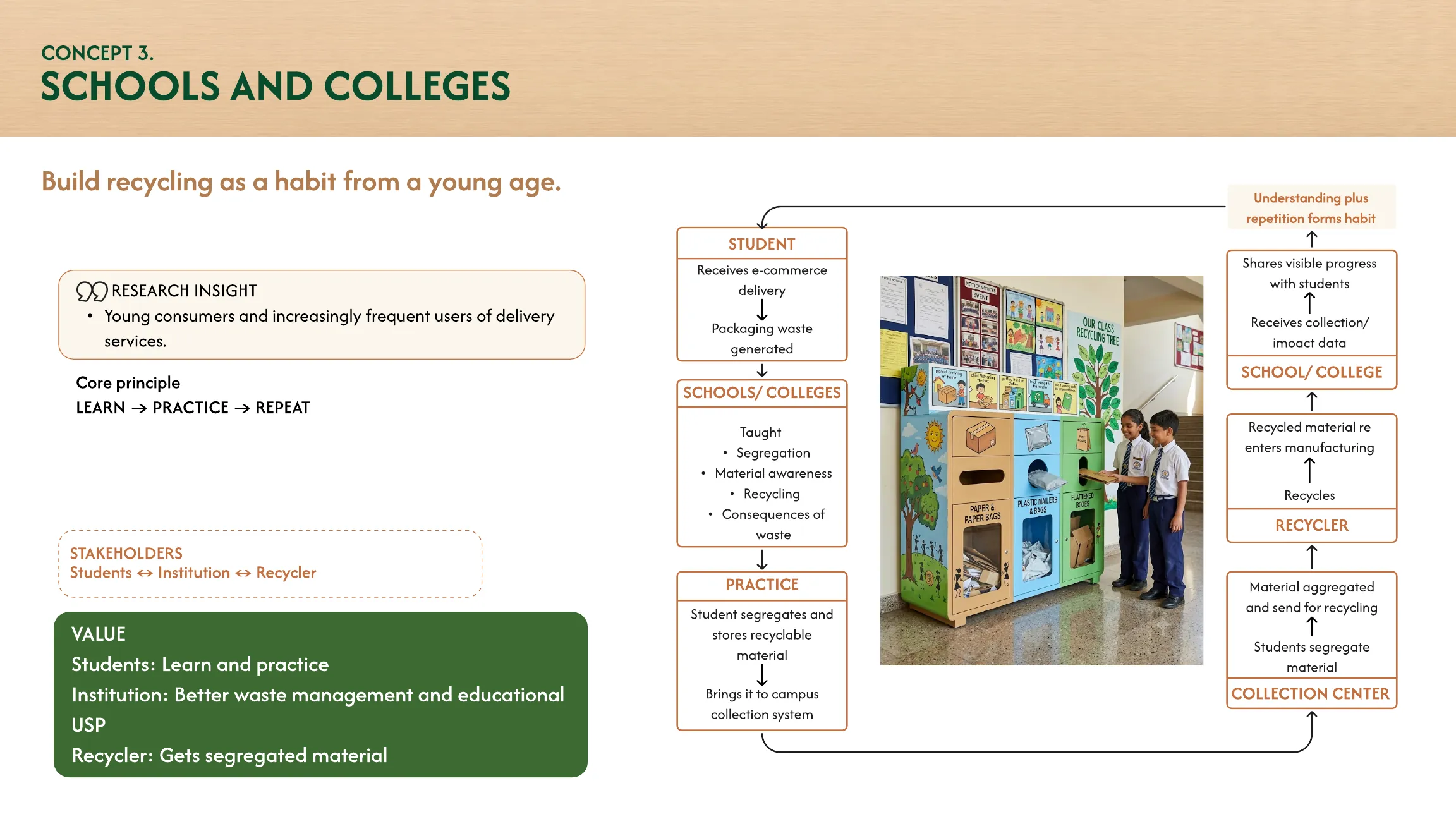
CONCEPT 3. SCHOOLS AND COLLEGES Build recycling as a habit from a young age. Understanding plus repetition forms habit STUDENT RESEARCH INSIGHT Young consumers and increasingly frequent users of delivery services. Core principle LEARN → PRACTICE → REPEAT STAKEHOLDERS Students ↔ Institution ↔ Recycler VALUE Students: Learn and practice Institution: Better waste management and educational USP Recycler: Gets segregated material Receives e-commerce delivery Shares visible progress with students Packaging waste Receives collection/ imoact data generated SCHOOLS/ COLLEGES Taught Segregation Material awareness Recycling Consequences of waste PRACTICE Student segregates and stores recyclable material Brings it to campus collection system SCHOOL/ COLLEGE Recycled material re enters manufacturing Recycles RECYCLER Material aggregated and send for recycling Students segregate material COLLECTION CENTER
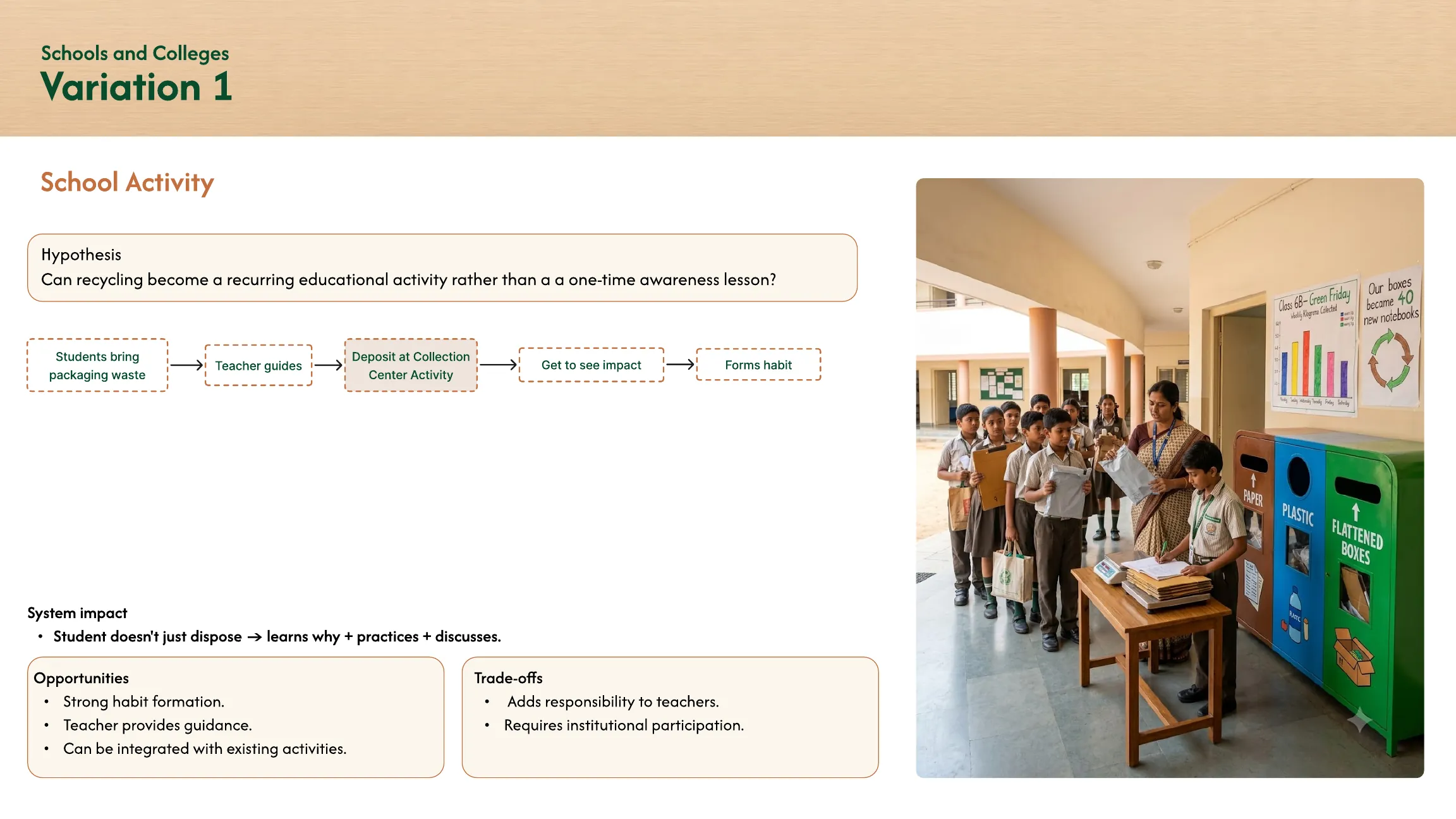
Schools and Colleges Variation 1 School Activity Hypothesis Can recycling become a recurring educational activity rather than a a one-time awareness lesson? Students bring packaging waste Teacher guides Deposit at Collection Get to see impact Center Activity Forms habit System impact Student doesn't just dispose → learns why + practices + discusses. Opportunities Strong habit formation. Teacher provides guidance. Can be integrated with existing activities. Trade-offs Adds responsibility to teachers. Requires institutional participation.
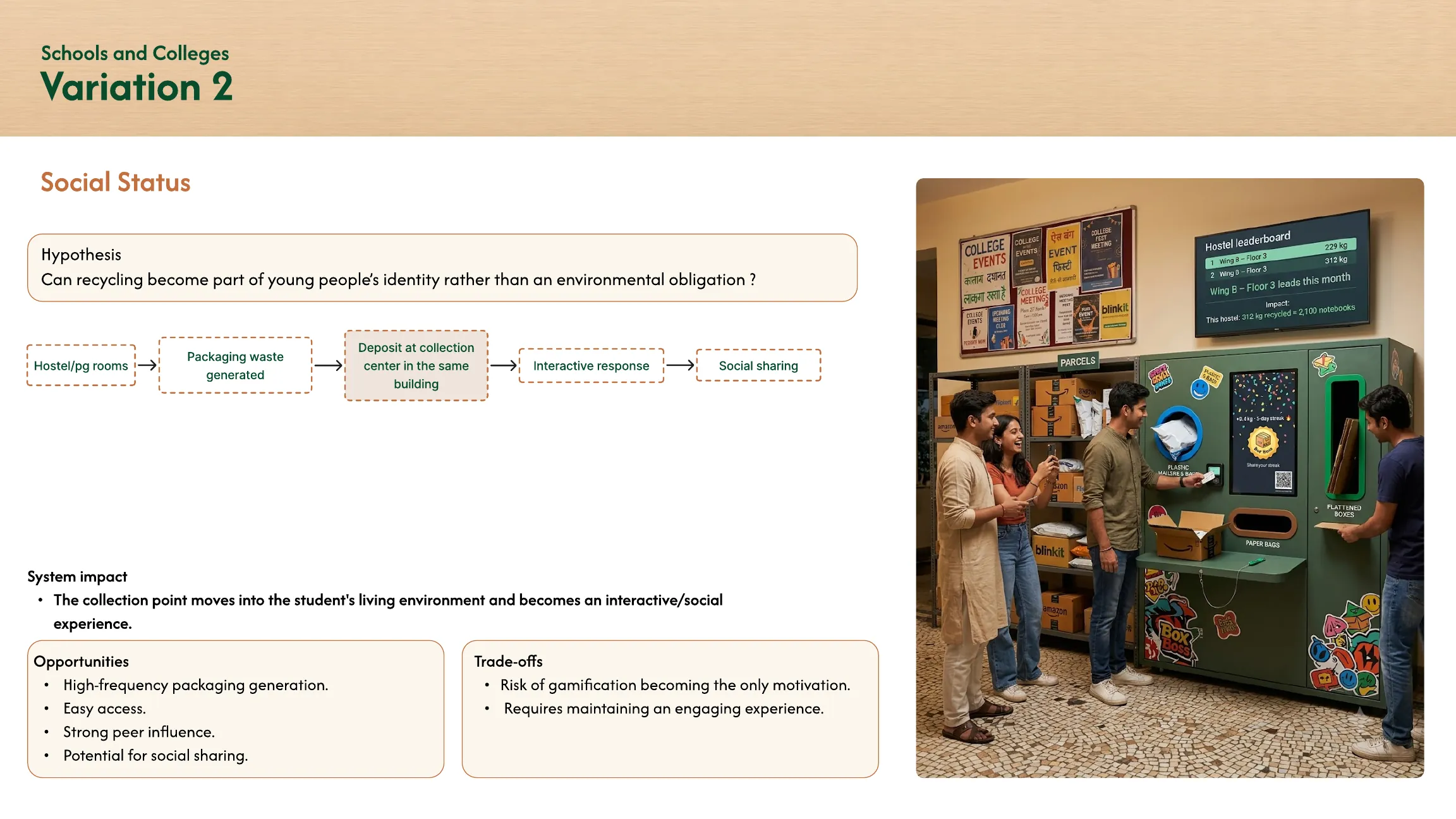
Schools and Colleges Variation 2 Social Status Hypothesis Can recycling become part of young people’s identity rather than an environmental obligation ? Hostel/pg rooms Packaging waste generated Deposit at collection center in the same Interactive response Social sharing building System impact The collection point moves into the student's living environment and becomes an interactive/social experience. Opportunities High-frequency packaging generation. Easy access. Strong peer influence. Potential for social sharing. Trade-offs Risk of gamification becoming the only motivation. Requires maintaining an engaging experience.
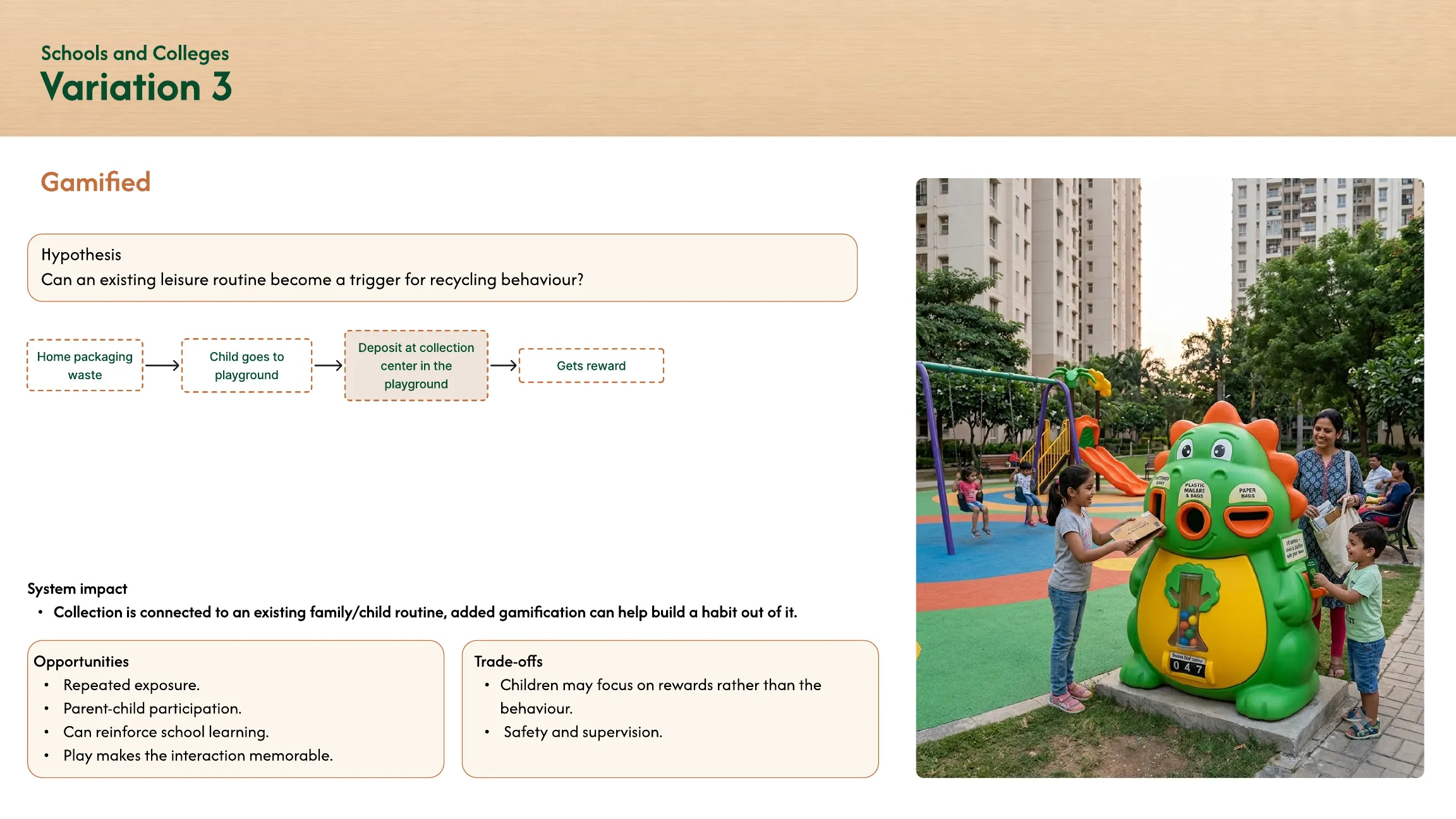
Schools and Colleges Variation 3 Gamified Hypothesis Can an existing leisure routine become a trigger for recycling behaviour? Home packaging Child goes to waste playground Deposit at collection center in the Gets reward playground System impact Collection is connected to an existing family/child routine, added gamification can help build a habit out of it. Opportunities Repeated exposure. Parent-child participation. Can reinforce school learning. Play makes the interaction memorable. Trade-offs Children may focus on rewards rather than the behaviour. Safety and supervision.
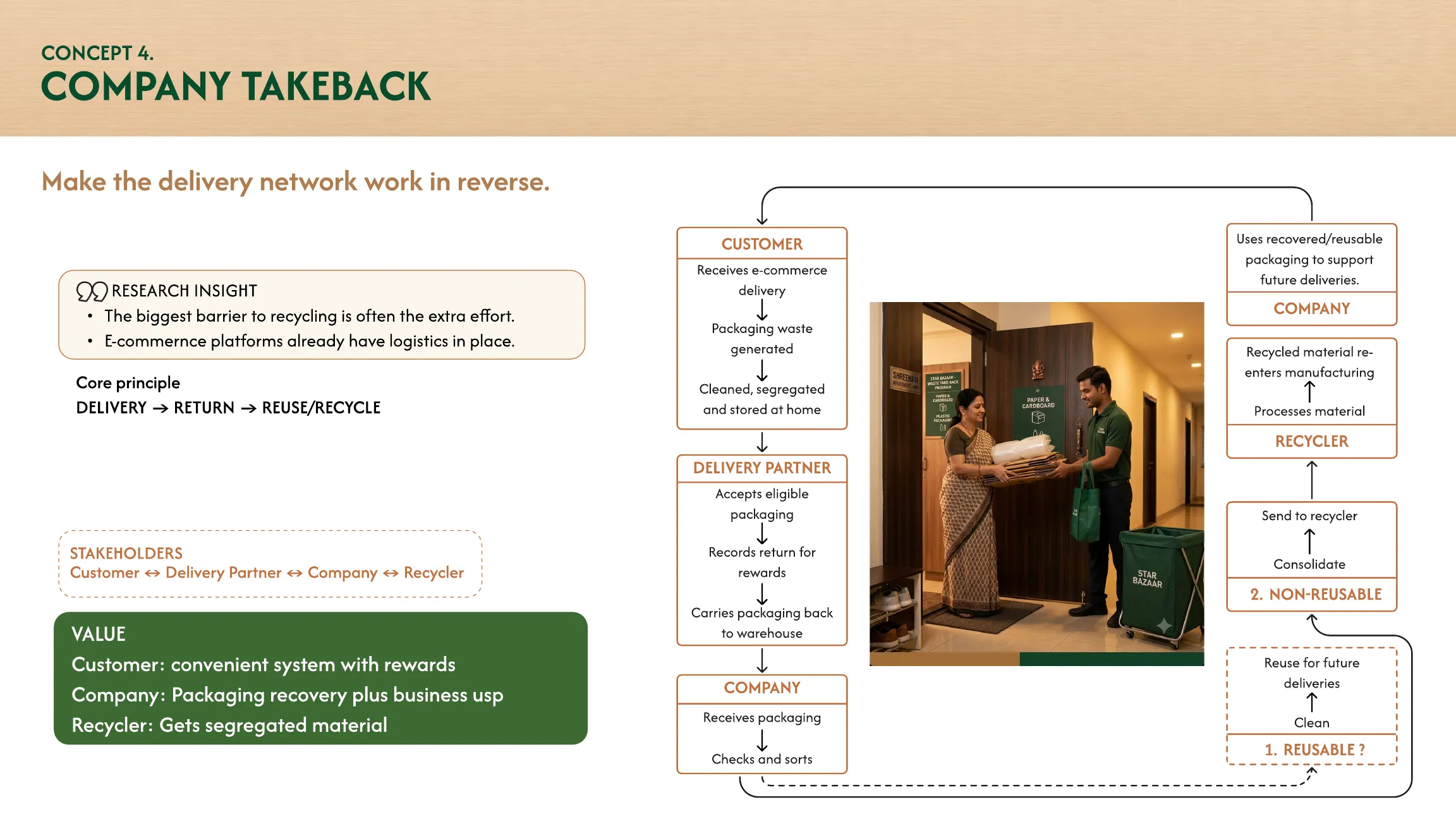
CONCEPT 4. COMPANY TAKEBACK Make the delivery network work in reverse. CUSTOMER RESEARCH INSIGHT The biggest barrier to recycling is often the extra effort. E-commernce platforms already have logistics in place. Core principle DELIVERY → RETURN → REUSE/RECYCLE Receives e-commerce delivery Packaging waste generated Cleaned, segregated and stored at home DELIVERY PARTNER STAKEHOLDERS Customer ↔ Delivery Partner ↔ Company ↔ Recycler VALUE Customer: convenient system with rewards Company: Packaging recovery plus business usp Recycler: Gets segregated material U ses recovered/reusable packaging to support future deliveries. COMPANY Recycled material reenters manufacturing Processes material RECYCLER Accepts eligible packaging Send to recycler Records return for rewards Consolidate Carries packaging back to warehouse COMPANY Receives packaging Checks and sorts NON -REUSABLE Reuse for future deliveries Clean REUSABLE ?
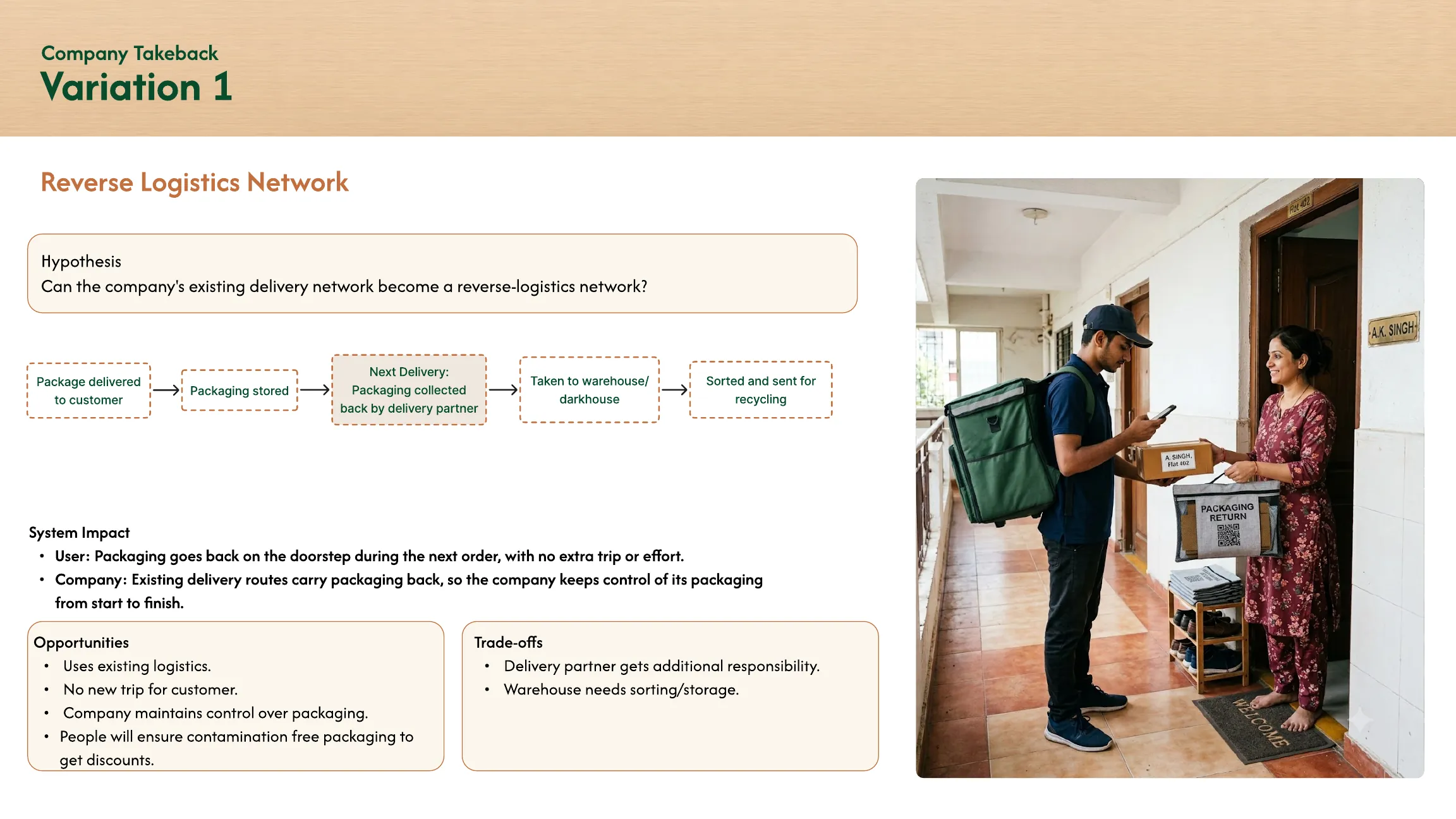
Company Takeback Variation 1 Reverse Logistics Network Hypothesis Can the company's existing delivery network become a reverse-logistics network? Package delivered to customer Packaging stored Next Delivery: Packaging collected back by delivery partner Taken to warehouse/ darkhouse Sorted and sent for recycling ystem Impact User: Packaging goes back on the doorstep during the next order, with no extra trip or effort. Company: Existing delivery routes carry packaging back, so the company keeps control of its packaging from start to finish. S Opportunities Uses existing logistics. No new trip for customer. Company maintains control over packaging. People will ensure contamination free packaging to get discounts. Trade-offs Delivery partner gets additional responsibility. Warehouse needs sorting/storage.
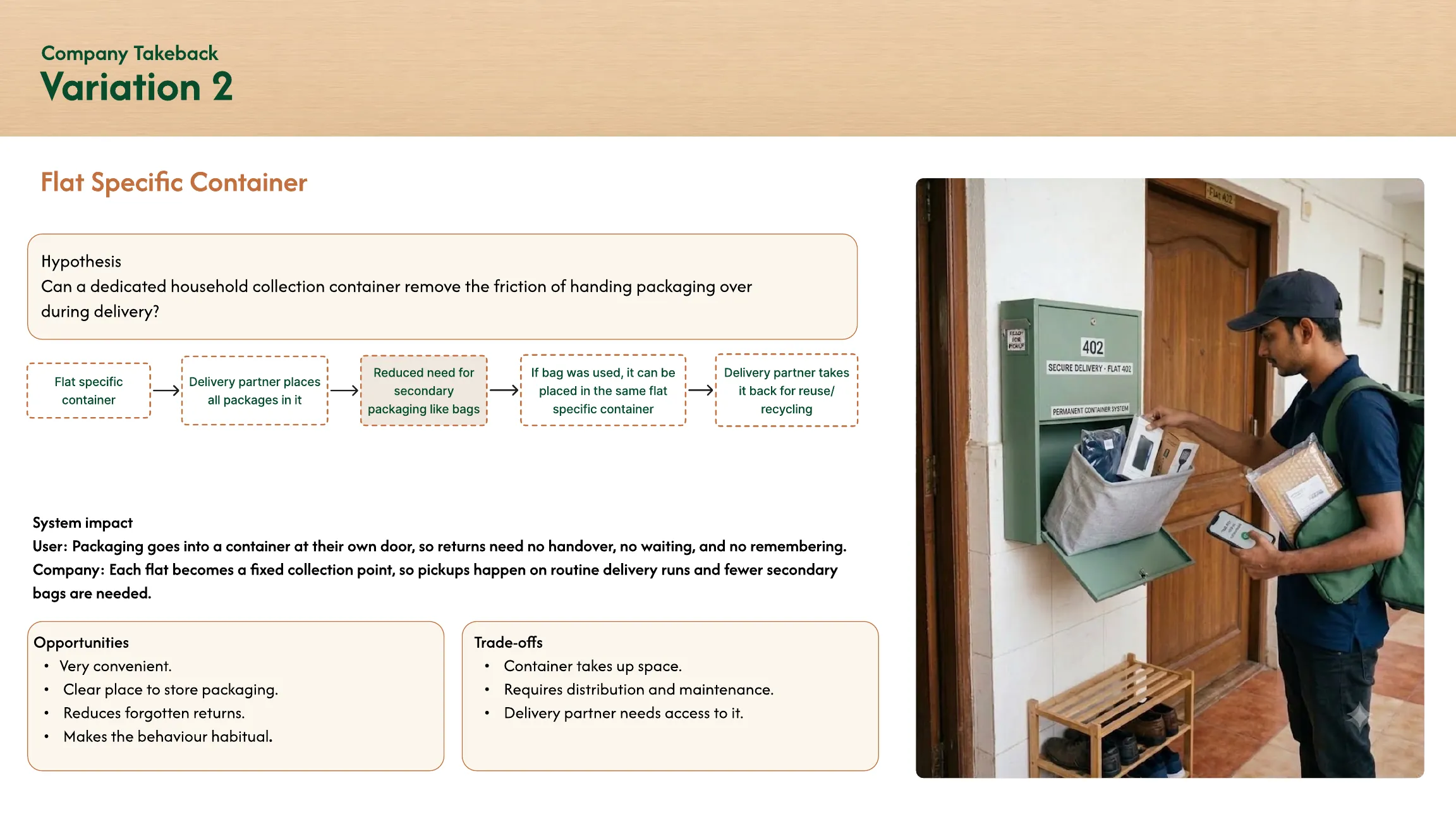
Company Takeback Variation 2 Flat Specific Container Hypothesis Can a dedicated household collection container remove the friction of handing packaging over during delivery? Flat specific container Delivery partner places all packages in it Reduced need for secondary packaging like bags If bag was used, it can be placed in the same flat specific container Delivery partner takes it back for reuse/ recycling System impact User: Packaging goes into a container at their own door, so returns need no handover, no waiting, and no remembering. Company: Each flat becomes a fixed collection point, so pickups happen on routine delivery runs and fewer secondary bags are needed. Opportunities Very convenient. Clear place to store packaging. Reduces forgotten returns. Makes the behaviour habitual. Trade-offs Container takes up space. Requires distribution and maintenance. Delivery partner needs access to it.
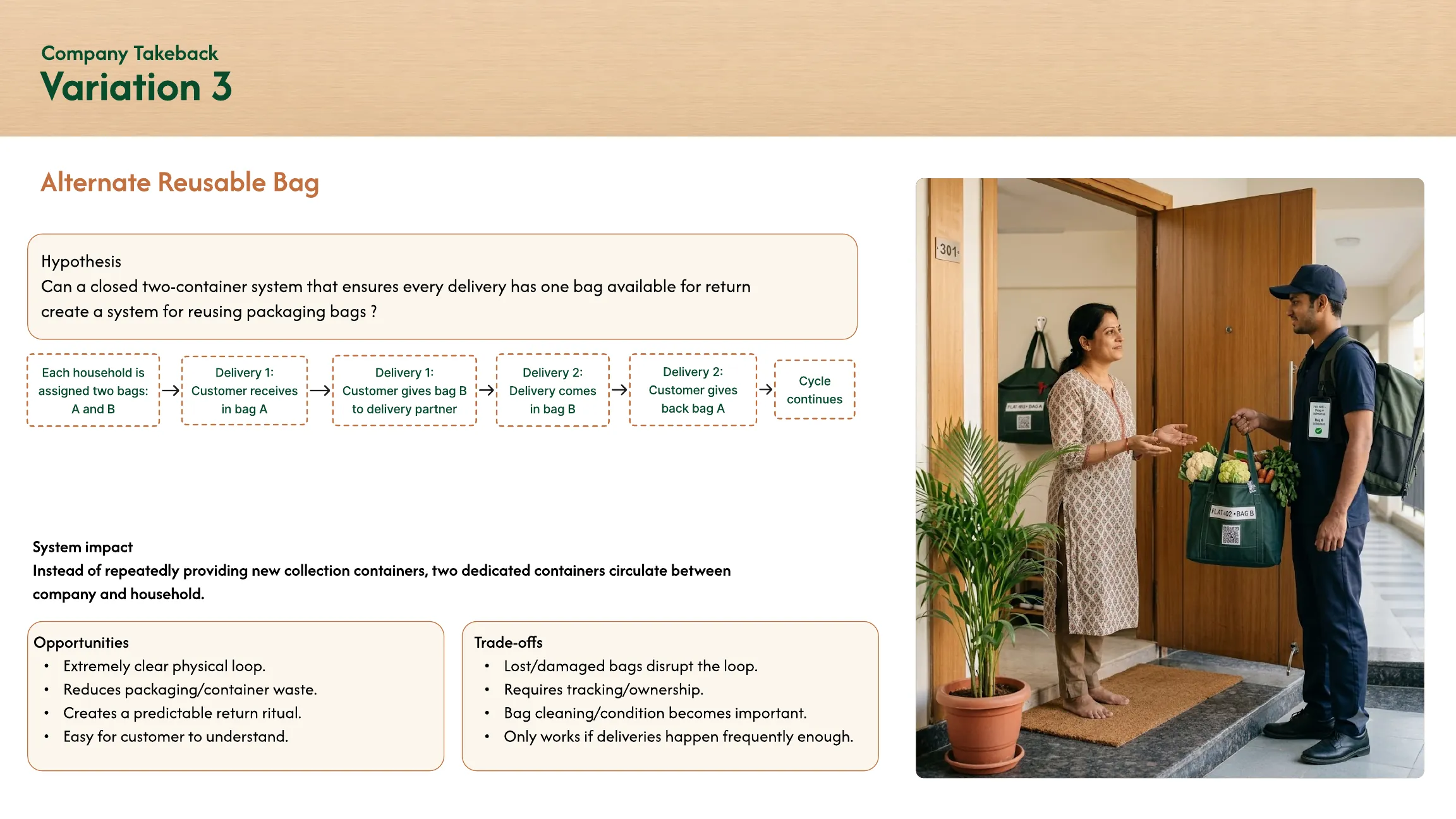
Company Takeback Variation 3 Alternate Reusable Bag Hypothesis Can a closed two-container system that ensures every delivery has one bag available for return create a system for reusing packaging bags ? Each household is assigned two bags: A and B Delivery 1: Customer receives in bag A Delivery 1: Customer gives bag B to delivery partner Delivery 2: Delivery comes in bag B Delivery 2: Customer gives back bag A Cycle continues ystem mpac S i t Instead of repeatedly providing new collection containers, two dedicated containers circulate between company and household. Opportunities Extremely clear physical loop. Reduces packaging/container waste. Creates a predictable return ritual. Easy for customer to understand. Trade-offs Lost/damaged bags disrupt the loop. Requires tracking/ownership. Bag cleaning/condition becomes important. Only works if deliveries happen frequently enough.
Thank You